Champion Hill 150th Anniversary Event

Yesterday I attended the commemoration of the 150th Anniversary of the Battle of Champion Hill. This event was really special to me, as the Battle of Champion Hill spurred my interest in the Civil War and led to me becoming an historian.

Schedule of Events for the Champion Hill Commemoration

Schedule of Events for the Champion Hill Commemoration

The featured speaker at the Champion Hill commemoration was Bertram Hayes-Davis, G-G grandson of Jefferson Davis. In addition to being the direct descendant of the Confederate president, Hayes- Davis is also the executive director of Beauvoir, Jefferson Davis’ post-war home on the Mississippi Gulf Coast.

Bertram Hayes-Davis, G-G- Grandson of Jefferson Davis, was the speaker at the commemoration

Bertram Hayes-Davis, G-G- Grandson of Jefferson Davis, was the speaker at the commemoration

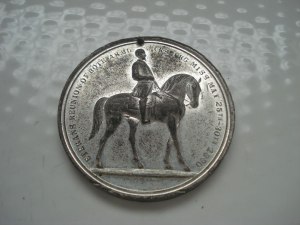
For me, the highlight of the day was the presentation of medals to the descendants of the men who fought at Champion Hill. There were a number of descendants of well-known Civil War soldiers present to accept medals: I saw relatives of General Alvin P. Hovey, General Stephen D. Lee, and General Francis M. Cockrell. I can’t claim kinship to a notable such as these, but I was very proud to accept a medal on behalf of my G-G-G- grandfather, Private Littleton H. Johnson and my G-G-G Uncle, Captain W.A. Harper, both of whom fought in the battle with Company D, “Lowry Rifles,” 6th Mississippi Infantry.

These medals were presented to the descendants of the men who fought at Champion Hill

These medals were presented to the descendants of the men who fought at Champion Hill

As I sat with the other descendants of the soldiers that fought at Champion Hill waiting for the medal presentation to start, I chatted with the man sitting next to me whose relative fought with an Ohio Infantry regiment in the battle. As I looked around I saw other families, some whose relatives fought for the blue, others that had fought for the gray, all laughing, talking and having a good time. I was reminded of the words written by Sam Watkins who served in the 1st Tennessee Infantry:

America has no north, no south, no east, no west. The sun rises over the hills and sets over the mountains, the compass just points up and down, and we can laugh now at the absurd notion of there being a north and a south. We are one and undivided.

Sam Watkins served in the 1st Tennessee Infantry. His book "Company Aytch," is an excellent account of what life was like during the war for the average Confederate soldier.

Sam Watkins served in the 1st Tennessee Infantry. His book “Company Aytch,” is an excellent account of what life was like during the war for the average Confederate soldier.

Posted in Uncategorized | 2 Comments

War Relics May Still Be Found Hereabouts…

During my forty-five years I have managed to put together a modest collection of artifacts related to the American Civil War – everything from the canister shot I bought at a flea market for fifty cents as a child to the Enfield Rifle I dug from a Union camp site in Vicksburg.

Pattern 1853 Enfield Musket Dug from a Union Camp at Vicksburg by the Author

Pattern 1853 Enfield Musket Dug from a Union Camp at Vicksburg by the Author

Relics of the “late unpleasantness” have always had a power to transport me to a time and place which I find so fascinating – by holding something as simple as a minie ball in my hand I can instantly time-travel to Manassas, or Sharpsburg, or Vicksburg – the battlefields where our nation’s history was written in blood. This obsession I have with the tangible remains of the Civil War is certainly not a new thing – the collecting of artifacts began while the conflict was still being fought, and continues straight through to this day.

For 9 1/2 years I had the good fortune to work as an historian at the Old Court House

The Old Court House Museum in Vicksburg

The Old Court House Museum in Vicksburg

Museum in Vicksburg, where I was surrounded by thousands of relics from the war. In my time there I spent many hours pouring through the musty newspaper collections in our research library, and I was surprised by how many articles I found that mentioned the discovery of Civil War artifacts. What follows are some of the most interesting stories that I have found in which Civil War artifacts play a central role.

In July 1861, the citizens of Vicksburg were electrified by the news of a Southern victory at the Battle of First Manassas. On August 9, 1861, the Vicksburg Daily Whig announced to its readers that it had a genuine relic of the battle to show to the public:

A Trophy – We received yesterday from Gen. Patridge, by Adams’ Express, a musket barrel, picked up on the Manassas battle field by Mr. Vincent Corrie, a member of the Volunteer Southrons. It belonged to a private of one of the New York regiments, and was found by the side of a federal soldier as he lay dead, the morning after the battle. The barrel bears the marks, it is supposed, of several bayonet thrusts and sabre cuts, and at one end is the impression of a cannon ball, which has bent and twisted it terribly. It can be seen at our office.

The soldier mentioned in the article was Vincent Corre, a private in Company A, 21st Mississippi Infantry. His regiment missed participating in the battle by about a day, but they were stationed near Manassas afterwards, affording the men the opportunity to do some souvenir collecting. Corre served with the 21st Mississippi until a wound to the knee at Gettysburg ended his duty as a front line soldier. Afterwards he was detailed to the Ordnance Department in Richmond.

At times during the war soldiers took items from the enemy for plunder; but in the following case, the items in question were taken to satisfy a debt of honor between two brother Masons, one Rebel, one Yankee. The following story was published in the Vicksburg Daily Herald, August 4, 1864, and in the Milwaukee Sentinel, December 17, 1863:

A MASONIC INCIDENT – We are told the following circumstances in regard to the

Civil War Era Masonic Watch Fob

Civil War Era Masonic Watch Fob

death of Lieut. Tinkham, who was killed in the second battle of Corinth: It apppears that Lieut. Tinkham was not seriously wounded when the rebels took possession of that part of the field where he fell, but was only shot through the leg, and as our boys were contesting the advance of the enemy with desperate bravery. Lieut. Tinkham raised himself upon his elbow, to see the fighting, when another leaden messenger pierced his body and he fell to the ground again. Seeing that he must soon be numbered among the slain, and that his life-blood was fast flowing out, he made the grand hailing sign to a passing rebel, who immediately came to Tinkham’s side, and rendered him all assistance in his power. Just before he expired he handed the rebel his watch and some money, with the instructions to forward it to his family the first opportunity he had, and a few moments after expired…Time rolls on, and on the Fourth of July, thirty-five thousand rebels surrendered to our victorious army at Vicksburg, and among that vast multitude we find Lieut. Tinkham’s friend eagerly searching for the 14th Wisconsin regiment. He found the regiment and safely delivered the watch and money to one of its members, and disappeared among the throng. The articles have been received by Mr. Tinkham’s friends in this county.

The Oshkosh Public Museum in Wisconsin has in its collection a letter written by Colonel John Hancock, commander of the 14th Wisconsin, on October 20, 1862. In this letter he mentions the death of Lieutenant Tinkham, and in the process gives a poignant look into the toll that the war took on those placed in command of other men:

God has been kind to me darling. He has brought me out of dangers that you know not of. A kind and beneficent hand has protected me in my times of peril and what I most fear is that my life is not in accordance with such kindness: that I am not sufficiently thankful for such blessings and such mercies. Four hard contested fields now I have taken an active part: Blackburn’s Ford; Bull Run; Shiloh; and Corinth. In all, that same care has been over me…My noble and brave boys are happy in camp tonight: music in different parts of the camp; joking, talking and laughing. They seat themselves around the campfires and joyously thus they pass their time away: no care, no responsibility. Sometimes I think I [would] rather be in the ranks with them than with the responsibility of a regiment on my hands…Upon our last battlefield I lost three of my bravest and best: Captain L.W. Vaughn of Kewanee County; Captain Samuel Harrison of De Pere, Wisconsin, and Lieutenant Samuel A. Tinkham of Waupaca. They were all my friends. After I assumed command of my Regiment, I had Lieutenant Tinkham promoted for bravery at Shiloh…He was a very fine, principled, quiet young man, brave and liked by all. Such my darling are the vicissitudes of war: some to glory and some to the grave.

When the war ended in 1865, peace returned to Mississippi, but the debris of battle that littered the landscape could still find new victims, as their article from the Vicksburg Daily Herald, April 23, 1868, explained:

KILLED – We are informed that two negroes of a prying turn of mind, who were endeavoring to pry off the cap of an unexploded shell, were blown into eternity on yesterday evening, near the residence of Mr. Henry Hammett. We do not mean that the residence of Mr. Hammett is any where in the neighborhood of eternity, but we are of the opinion that the negroes imagine they are now, yet when last seen they and the shell were near Mr. Hammett’s.

Another story in a similar vein although with less fatal results was published in the Vicksburg Daily Herald on February 7, 1872:

Explosion at Jackson – At about eight o’clock last evening, a loud explosion was heard in the western part of the city, which caused some to think that a steam boiler had collapsed a flue, or that the Federal troops were once more bombarding Jackson…It appears that a blast was being melted at the Ecelsior Foundry, in West Jackson, and among the old iron placed in the cupola were two shrapnel shells, relicts of the late little unpleasantness, which had been purchased by the proprietors at the foundry to transform into more useful, and certainly more ornamental materials. These shells were supposed to be as harmless as cast-iron lions at a park gate, or sleeping sculptured lambs on a tombstone, but they chanced to be loaded, and when sufficiently heated went off…Fortunately no one was killed.

Not all relic related stories in the immediate post-war period were so explosive in nature – another article published in the Vicksburg Daily Herald on March 5, 1868, was simply concerned with an interesting artifact from the Siege of Vicksburg:

During the siege of Vicksburg it is reported that two balls – one a minie and the other from a Belgian rifle – fired from opposite points, met in mid-air and were almost completely welded together.

Among the most moving artifacts to be reported on were those found when the lost graves of soldiers were accidentally disturbed. This article from the Atlanta Constitution was saved by Sophie Goodrum of Vicksburg in her scrapbook, and it illustrates the reverence that Southerners had for relics that belonged to their fallen soldiers:

WHO ARE THEY? – Photographs Buried In A Fallen Soldier’s Grave. Editor Constitution:SCAN1109 Just beside me as I write is a picture we handle with tenderness and sad emotions. It has been buried perhaps twenty-eight years next to the heart of a soldier. On the works of the new Belt line railroad, four miles from Atlanta, at Black’s dairy farm the diggers unearthed some human bones and skulls, and investigation of the grounds showed the lines of the Confederates. Last Sabbath Captain McKelvey, J.M. Hainey and others sought further into the excavation made by the railroad and found the picture mentioned, besides Confederate buttons and a clay pipe…It is an old-time daguerreotype and represents a young woman and man, perhaps sister and brother, somebody’s boy or somebody’s husband, watched for in vain; his burial place unknown to his loved ones. Relics like this must ever be regarded with tenderness. Mementoes small within themselves become valuable beyond price to those loved ones remembering the brave heart that gave its life for its country. (Sophie Goodrum Scrapbook #6, Old Court House Museum, Vicksburg, Mississippi)

There was so much iron and lead strewn over the landscape after the war that some enterprising locals were able to make a lively business of collecting it:

A great many relics of the war still continue to be picked up on the whole battlefields near Vicksburg, and there is hardly a day passes that a local junk dealer does not buy quantities of lead bullets. To give something of the idea of the amount of lead the ‘Yanks’ rained down upon the city, the books show that he has brought and shipped some seventy-five tons of leaden bullets, not including shell, solid shot, etc., and he did not enter the business until two or three years after the larger portion of the trade was over, and some half a dozen other establishment in the city buying at the same time, and still the supply is not exhausted. (New Orleans Times, October 3, 1877)

This collection of Civil War artillery shells belonged to  Z.M. Davis, who owned the National Park store in the early 1900s which was adjacent to the Vicksburg National Military Park. Along with soft drinks and gas, Davis sold Civil War relics to tourists - Old Court House Museum

This collection of Civil War artillery shells belonged to Z.M. Davis, who owned the National Park store in the early 1900s which was adjacent to the Vicksburg National Military Park. Along with soft drinks and gas, Davis sold Civil War relics to tourists – Old Court House Museum

As the years went by and the 19th century gave way to the 20th, time took its toll on the surviving Civil War veterans. By the third decade of the new century there only a handful of old soldiers left in Vicksburg. While most of the men who had fought for the Hill City were gone, many tangible reminders of the fighting they had done still remained. From the fortifications they dug, to the minie balls they fired from their muskets, to the iron shot and shell belched from hundreds of cannon, Civil War relics littered the landscape in a wonderful variety.

The sheer quantity of artifacts available in Vicksburg at this time was documented at great

V. Blaine Russell, Vicksburg newsman and relic hunter, taken in 1954 - Old Court House Museum

V. Blaine Russell, Vicksburg newsman and relic hunter, taken in 1954 – Old Court House Museum

length by V. Blaine Russell, a columnist for the Vicksburg Evening Post, who wrote for the paper from the 1930s to early 1950s. A keen observer of all things Civil War related, Mr. Russell often mentioned in his column the wartime relics he spotted as he wandered about town on foot. A lover of the path less traveled, Russell often found reminders of the war in out of the way places, such as one of the caves Vicksburgers carved into the soft, loamy earth to shelter from the Federal bombardment during the siege of the city:

James Farrell, venerable citizen, has spent most of his long life in Vicksburg. As a small boy during the siege his family cave was behind the present J.B. Smith home on Second North Street. Mr. Farrell remembers the cave had one entrance but two separated rooms back inside – one for the males and one for the womenfolks. The siege cave still open in a ravine off Lovers’ Lane is of that construction – one door, but two rooms. Today it is so obscure and brush-hidden few know hot to find its mouth. (V. Blaine Russell Scrapbook, Volume 1, Old Court House Museum collections, Vicksburg)

Russell had a knack for eyeballing relics, and he loved to relate his latest finds to his readers:

War relics may still be found hereabout. On a Wednesday’s nosing we picked up twenty minie balls and buck and balls; also the metal base of a Civil War scabbard.

Reading Mr. Russell’s columns now, it boggles the mind that relics were once so plentiful that he could make the following report:

Went again on a lone investigation of the spot where lately we dredged out 106 minie balls and fragments of shrapnel. This last time we found fourteen more bullets and five fragments of shrapnel in the same hole. We theorize now that perhaps this cache of missiles got in one spot because Confederates were being shot at there as they came down to the water hole to fill their canteens; or perhaps some soldier died there and his load of ammunition settled about his body. (V. Blaine Russell Scrapbook, Volume 1; exact date of the column is unknown, but it was sometime in November 1937)

Artillery shells were so common in the Hill City that Mr. Russell noted:

In Vicksburg, cannonball gate and doorway ornaments are not unusual. You see them in many places. Sometimes they are well matched, again they are not. There is a well-balanced quadruplet of missiles on the Collier front lawn at Speed and Washington. Two of them are the big mortar shells, the other two are the bullet shaped missiles. (V. Blaine Russell Scrapbook, Volume 1; exact date is unknown, but it was sometime in February 1937)

Abandoned cannon were some of the largest relics which littered the Vicksburg landscape. Peter Forbus sits reading his paper near an abandoned 10-inch Columbiad, circa 1880s - Old Court House Museum

Abandoned cannon were some of the largest relics which littered the Vicksburg landscape. Peter Forbus sits reading his paper near an abandoned 10-inch Columbiad, circa 1880s – Old Court House Museum

Time marches on, as it inevitably does, and in the 21st Century, relics are not as plentiful as they once were, but to the dedicated searcher, they can still be found. In the March 3, 1999, edition of The Vicksburg Evening Post, the paper reported that a 20-pounder Parrott shell had been found in the National Miltary Park, and that it was the third to be found that year.

As long as these bits of lead, iron, and brass continue to surface, stories will be written about them, reminding us of a time, not so very long ago, when brother fought against brother.

Posted in Uncategorized | Leave a comment

Showing of the The Crisis May 11 at Vicksburg

Some time ago I posted an article about The Crisis, a Civil War epic that was the first feature length film shot in Mississippi. For those who have not read it, the article can be found here: http://mississippiconfederates.wordpress.com/2011/10/19/the-crisis-mississippis-first-civil-war-film/

The exciting news is that there is going to be a showing of the film at the Strand theater in Vicksburg on Saturday, May 11, at 7:00 p.m. There is only going to be one showing, so this is your only chance to see the movie. Tickets are available here: http://www.westsidetheatrefoundation.com/?p=471

I already have my ticket, so I hope to see you there!

Posted in Uncategorized | Leave a comment

The Confederates Grand March

Most of the time I have to hunt for material that I use in my blog, but the information for this particular post came to me, which I must say is a nice change of pace. My last blog entry concerned the filming of a group of Confederate veterans giving the Rebel Yell in 1932. The first veteran that was filmed was James Dinkins, who served in Company C, “Confederates,” 18th Mississippi Infantry.

One of my readers, who wishes to remain anonymous, contacted me after reading the blog, and told me that he had in his possession an original piece of sheet music dedicated to the “Confederates,” which was purchased by his ancestor in Vicksburg during the Civil War.

The original owner of the sheet music was William Oliver, who lived in Ouachita Parish, Louisiana. The front page even has a pencil notation on the cover, “Oliver, May 3, 1862.” William Oliver enlisted in the 31st Louisiana Infantry on July 2, 1862, serving as captain & quartermaster in the regiment.

Cover of the "Confederates Grand March"

Cover of the “Confederates Grand March”

The “Confederates” mustered into state service at Canton on April 22, 1861. The first captain of the company was Otho R. Singleton, who was a Mississippi representative to the United States Congress when the Civil War started. When the conflict began he explained why Mississippi had made the decision to leave the Union, saying: “Submission to such dictation and insult is not a term to be found in her vocabulary. To her vision there floats in the breeze but two banners – Upon the one is inscribed ‘Disunion,’ upon the other ‘Dishonor.’ Under the former she has ranged herself, prepared to take the consequences.”

Photograph of Otho R. Singleton taken in 1859 when he was a member of the 35th Congress - Library of Congress

Photograph of Otho R. Singleton taken in 1859 when he was a member of the 35th Congress – Library of Congress

William Oliver purchased the sheet music from Moody & Kuner in Vicksburg, who owned a jewelry store on Washington Street in Vicksburg. Both of these men are well known to me; Daniel N. Moody joined the 21st Mississippi Infantry in 1861, starting out as the captain of Company A, the “Volunteer Southrons.” He quickly showed his aptitude for the military, moving up to major, lieutenant colonel, and eventually colonel of the 21st Mississippi. He was wounded three times during the war, but survived the conflict and returned home to Vicksburg in 1865. Max Kuner was born in Bavaria in 1824, and he eventually immigrated to the United States and settled in Vicksburg. He lost everything he owned during he war, but he survived and began to rebuild in 1865. He left Vicksburg in the 1870s, and by the 1880s he had moved to Colorado, where he founded the Kuner Pickle Company and became a very successful businessman.

Close-up of the cover of the music, showing the Moody & Kuner stamp at the bottom

Close-up of the cover of the music, showing the Moody & Kuner stamp at the bottom

Receipt from Moody & Kuner - Briscoe Center for American History

Receipt from Moody & Kuner – Briscoe Center for American History

I can just imagine the Confederates marching out of Canton, Captain Singleton at their head, to the strains of the “Confederates Grand March.” The only problem is that I don’t want to just imagine it, I want to hear what the music sounded like. If one of the readers has some musical talent, and a camera, please contact me. I can send you high resolution scans of the music, and hopefully we can get a video of someone playing it on piano that we can upload to Youtube.

Can anyone play this?

Can anyone play this?

Posted in Uncategorized | Leave a comment

Our Glorious War Cry: A Mississippian Gives the Rebel Yell

This week I was looking on the internet to see if I could find some film footage of the 193o National United Confederate Veterans reunion, which was held in Biloxi. I was able to confirm that the film still exists, but I could not find it posted online. I did, however, find another film that really excited me, as it shows a Confederate veteran from Mississippi giving the “Rebel Yell.”

The video is in the collections of the Library of Congress, and was posted on the internet in 2011 by the Smithsonian. While looking for my Biloxi footage, I found this four-minute film on Youtube, and as recordings of Confederate veterans giving the Rebel Yell are very rare, I decided to invest four minutes and watch it, and boy am I ever glad I did. The film was not identified as to where or when it was taken, other than it was from the 1930s and was “Rare footage of Civil War veterans doing the Rebel Yell.”

Fortunately for history, the old veterans were introduced by name as each was filmed giving the Rebel Yell, and imagine my surprise when the first man up to the microphone was announced as “Captain James Dinkins,” a name I instantly recognized. He served in both the 18th Mississippi Infantry and the 18th Mississippi Cavalry, and was a prolific author after the war, writing many articles for Confederate Veteran magazine about his wartime experiences. He also wrote a book, 1861 to 1865: Personal Recollections & Experiences in the Confederate Army, which was published in 1897.

James Dinkins was born on April 18, 1845, in Madison County, Mississippi. As a teenager, he was sent to the North Carolina Military Institute in Charlotte, North Carolina. While a student there, he sat for this photograph wearing his cadet uniform. When the war started, he returned to Mississippi and joined the “Confederates,” Company C, 18th Mississippi Infantry. After two years he received a lieutenant's commission and served in the 18th Mississippi Cavalry. Image from 1861 to 1865 by an Old Johnnie, by James Dinkins, 1897.

James Dinkins was born on April 18, 1845, in Madison County, Mississippi.
As a teenager, he was sent to the
North Carolina Military Institute
in Charlotte, North Carolina.
While a student there, he sat for
this photograph wearing his cadet
uniform. When the war started, he
returned to Mississippi and joined
the “Confederates,” Company C,
18th Mississippi Infantry. After two years he received a lieutenant’s commission and served in the 18th Mississippi Cavalry. Image from 1861 to 1865 by an Old
Johnnie, by James Dinkins, 1897.

Without any further ado, I will let you watch the video:

After seeing this amazing video, which I believe is the only known film footage of a Mississippi Civil War veteran giving the “Rebel Yell,” I wanted to know more about how it came to be created, and who the other men were in the movie giving the famous war cry. After doing a little research online in a newspaper database, I had the answer to where and when the film was made: It was shot on February 20, 1932, at Camp Nicholls, in Louisiana. Located in New Orleans, Camp Nicholls was established in the 1880s as a veteran’s home for former Confederate soldiers.

Picture postcard from the early 1900s of Camp Nicholls

Picture postcard from the early 1900s of Camp Nicholls

The filming of the old veterans giving the Rebel Yell was the brainchild of the Times-Picayune newspaper. In the February 11, 1932, issue they explained why the movie was needed:

Few members of the ‘younger generation’ have heard the ‘Rebel Yell,’ and even fewer of these remember the definite sound of this battlecry. During the past few years the veterans’ ranks have been rapidly thinned by death. Immediate steps must therefore be taken to preserve the yell, which children of the South will see mentioned in records of the War Between the States and will hear mentioned in the tales of the war handed down through generations. Making of a talking picture was suggested by the Times-Picayune to officers of the U.D.C. as the best way to preserve the battlecry.

The Times-Picayune arranged for Harcol Motion Picture Industries to film the Rebel Yell, and with the publicity the newspaper was able to give the project, Confederate veterans residing at Camp Nicholls, and others living in the area, quickly pledged to be part of the project. One of those veterans who agreed to participate was James Dinkins, who had moved to New Orleans about 1900. The newspaper gave the event plenty of publicity, writing numerous articles about the upcoming filming, and including pictures of the veterans who would participate:

The Times-Picayune, April 18, 1932

The Times-Picayune, February 18, 1932

This picture of Captain Dinkins and his wife was published in the Times-Picayune on February 17, 1932

This picture of Captain Dinkins and his wife was published in the Times-Picayune on February 17, 1932

In the February 17, 1932, edition of the Times-Picayune, the paper wrote that Captain Dinkins thought the idea to record the Rebel Yell “Is a splendid idea.” He went on to say that “When the fast-thinning ranks are gone, left behind us in Memorial Hall will be a record of our songs and of our glorious war cry.”

On the day of the filming, a large crowd turned out to see the Confederate veterans give the Rebel Yell. A reporter for the Times-Picayune wrote: “The group turned down leaves of the calendar and prepared for the future a glimpse into the past – so much more intense in the making than in the telling…Spontaneous applause broke from all corners of the grounds as veterans of the Soldiers’ Home marched out. They wore Confederate jackets of gray and ‘rebel’ caps. Their coats were burdened with medals that brought queries and stories of where they were won…the crowd heard them give the ‘rebel yell.’ Its members suddenly were reminded that this was the cry that had sent soldiers and their families through blood and starvation to see the war through.”

The front page of the Times-Picayune included this picture of the Confederate veterans giving the Rebel Yell - February 21, 1932

The front page of the Times-Picayune included this picture of the Confederate veterans giving the Rebel Yell – February 21, 1932

I was eager to find out who the other men were that gave the Rebel Yell, and fortunately all of them are identified by name on the film and in the Times-Picayune. By going through Confederate service records and the pension records from the state of Louisiana, I believe I have correctly identified the units in which these men fought:

The first speaker on the film is Dr. Ernest S. Lewis, who was president of the board of directors of Camp Nicholls and had served as a surgeon in the 3rd Georgia Cavalry; he introduces Superintendent Robert H. Hackney, who was in charge of the Camp Nicholls veterans home. Hackney served in Company D, 30th Louisiana Infantry during the war. The first to give the Rebel Yell was James Dinkins, who served in the 18th Mississippi Infantry and 18th Mississippi Cavalry. Dinkins was followed by Leonard Waller Stephens, who was commander in chief of the United Confederate Veterans; during the war he was a member of Company E, 27th Louisiana Infantry. Next was Charles P. Jones, who served in the 25th Tennessee Infantry. After Jones came Paul Villavaso, who served in Gaudet’s Company, St. James Regiment, Louisiana Militia. I believe he also served in the Pelican Light Artillery of Louisiana. Next came Cyrus LaGrange, who was a member of the 7th Louisiana Cavalry, Company B. After LaGrange came J.W. Manney, who was a member of Company A, 2nd Louisiana Cavalry, and may have served in Morgan’s Cavalry as well. Next came James M. Blount, who I believe served in Company A, 13th Louisiana Infantry. After Blunt came Frank E. Powell, who was a member of Companies A/E, 10th Louisiana Infantry in the Army of Northern Virginia. And last but not least was James Augustus Pierce, who fought with Company D, 7th Alabama Cavalry during the war.

James Dinkins lived another seven years after the movie was made, dying on July 19, 1939, in Saluda, North Carolina, while on a visit to his daughter. He was brought back to New Orleans and interred at Metairie Cemetery. The Times-Picayune noted in the July 20, 1939 edition that Dinkins would “Be attired in an officer’s uniform which, with a Confederate battle flag for the exterior of the coffin.”

The Times-Picayune planned to have a copy of the film deposited at Confederate Memorial Hall in New Orleans, and I plan to check and see if that institution does indeed have the film in their collections. The version on Youtube is only half of the footage that was originally shot, and the other four minutes consisted of older women of the United Daughters of the Confederacy, those that had actually lived through the war, singing a number of wartime songs such as “The Bonnie Blue Flag.”

The version of the film that is shown above, which is in the collections of the Library of Congress, was donated by New Orleans resident Don Perry, who worked for the local NBC affiliate in the city in the 1960s. According to one comment about the film on the Smithsonian website, the film was rescued from the trash by Perry, who realized its historical significance and had it remastered at his own expense. If this is true, Mr. Perry has done us a tremendous favor by saving this small slice of Civil War history that otherwise would have been lost.

Posted in Uncategorized | 4 Comments

Times-Picayune December 19, 1904

I found the following article in the Louisiana Times-Picayune some time back, and I am finally getting around to writing about it. It concerns Captain William T. Ratliff, a Confederate veteran, giving tours of the Champion Hill battlefield to Union veterans who

Captain Samuel J. Ridley, commander of Company A, 1st Miss. Light Artillery. He was killed at the Battle of Champion Hill.

Captain Samuel J. Ridley, commander of Company A, 1st Miss. Light Artillery. He was killed at the Battle of Champion Hill.

fought there on May 16, 1863. A lieutenant in Company A, 1st Mississippi Light Artillery, Ratliff”s unit was in the thickest of the fight, suffering 8 killed, 2 wounded, and 8 captured. Among the dead was the battery commander, Captain Samuel J. Ridley, shot down while trying to serve one of his cannon by himself after its crew was lost.

By a quirk of fate, Ratliff was not with his unit when it made its heroic stand at Champion Hill; 10 days prior to the battle he had been detailed to serve as the temporary commander of Battery C, 1st Mississippi Light Artillery, which was stationed at Snyder’s Bluff north of Vicksburg.

Jackson, Miss., Dec. 18, 1904

Captain W.T. Ratliff, one of Hinds County’s prominent citizens, who served with distinction in the Civil War, has received from two soldiers of the Northern Army letters which breathe the spirit of brotherly love. Captain Ratliff has given these letters to the press. They are as follows:

Cincinnati, Ohio, Nov. 27, 1904

Dear Captain Ratliff: I take the first opportunity following a busy week to thank you for your great courtesy in being my guide over to the left (your right) of the line occupied during the Champion Hill battle of May 16, 1863. It was a visit I have longed to make ever since the war, and it would have been impossible to have seen the ground under more favorable auspices or with better company.

As our three companies of the Eighty-Third Ohio were about all the infantry employed on the left, and as we had it so hot from your batteries all the afternoon, it made it all the more a day to be remembered by me – one of the fortunate ones. I would have liked to have hunted up the old piano at Edwards Station, where Champion says it now is, and seen whether its tone was as good as when we played it that evening, but perhaps another time will come.

The Coker House was as we left it and the surroundings little different, and if our regiment comes to the dedication next May at Vicksburg we shall try to make an expedition to the Coker house, if no further. Again tendering you my thanks and assurances of my appreciation of your kindness, I am, sincerely yours,

1985 photo of the Coker House on the Champion Hill battlefield - Library of Congress

1985 photo of the Coker House on the Champion Hill battlefield – Library of Congress

William M. Davis.

The other letter is from an Indiana man, as is as follows:

Fountain City, Ind., November 29, 1904.

Captain W.T. Ratliff, Raymond, Miss.: My Dear Friend – I am extremely sorry that we found it impossible to accept your kind invitation to visit you at your home, but in the language of the Rooseveltian period, we found our life a very strenuous one while in your state. The Sunday following our Champion Hill visit we visited the Chickasaw battle field, and on Monday we put in the day with Captain Rigby getting some matters in shape on the battle line around Vicksburg, and on Monday night we left for home.

General McGinnis is the Postmaster at Indianapolis, and had a ten-day leave of absence and had to get home or be mustered out as a deserter. Major Hill and myself did not like to let him go home by himself. I am sure that we, not you, were the losers in not visiting you at your home. I know we should have enjoyed it very much. I think I heard General McGinnis tell a dozen times about his trading knives with Captain Ratliff, and each time he showed the knife and said he would not take $50 for it. (Captain Ratliff says he got the best of Major McGinnis in the trade.) The fact is that we all came home completely in love with the people of the South, who each and every one treated us so splendidly. This is not to be wondered at. After all, we are all American citizens, and to the people belongs the whole country, and no class of people understands this so well as the ex-soldiers of both armies. There has been no fight between them and has not been since April 1865. I brought the ‘whole armada’ story home with me, and have had the satisfaction of telling to many times, and it universally brings down the house. I think it the best army story I ever heard, and especially coming from the source it did. With every good wish for you and Mrs. Ratliff and those you love, believe me, sincerely yours,

M.M. Lacey

It has been the policy of this grand old man of Hinds County to pilot quite a number of former Federal soldiers over the old battle field of Champion Hill, and he has quite a number of warm personal friends among those who were formerly arrayed against him in deadly conflict.

A rare photograph taken at the dedication of the General Lloyd Tilghman monument on May 18, 1909, at Champion Hill. Pictured left to right: the two men on the end are thought to be Sid E. Thomas and W.M. Robb from Edwards; unidentified woman florist from Vicksburg; Ike Caston, land owner (standing behind the florist); Frederick Tilghman, son of General Tilghman kneeling; behind Tilghman are Charles Turner and David Butcher, Tilghman’s banker and lawyer from New York City. To the right of the stone are: presumably Oswald Tilghman, relative and Aide-de-Camp to General Tilghman; William T. Rigby, Superintendent of the Vicksburg National Military Park; kneeling beside the stone is Sidell Tilghman, General Tilghman’s son; Captain W. T. Ratliff, standing behind Tilghman; J. W. Ratliff standing beside his brother to the right and Henry Hudson Kitson, sculptor from Boston, to the far right. Photograph courtesy of Mississippi Department Archives and History

A rare photograph taken at the dedication of the General Lloyd Tilghman monument on May 18, 1909, at Champion Hill. Pictured left to right: the two men on the end are thought to be Sid E. Thomas and W.M. Robb from Edwards; unidentified woman florist from Vicksburg; Ike Caston, land owner (standing behind the florist); Frederick Tilghman, son of General Tilghman kneeling; behind Tilghman are Charles Turner and David Butcher, Tilghman’s banker and lawyer from New York City. To the right of the stone are: presumably Oswald Tilghman, relative and Aide-de-Camp to General Tilghman; William T. Rigby, Superintendent of the Vicksburg National Military Park; kneeling beside the stone is Sidell Tilghman, General Tilghman’s son; Captain W. T. Ratliff, standing behind Tilghman; J. W. Ratliff standing beside his brother to the right and Henry Hudson Kitson, sculptor from Boston, to the far right.
Photograph courtesy of Mississippi Department Archives and History

I found a very good write-up about William T. Ratliff on the Mississippi Department of Archives and History website – the man had quite a career after the Civil War:

William Thomas Ratliff was born in Raymond, Mississippi, on September 16, 1835. His parents were William Ratliff of Pike County, Mississippi, and Jane Davis of Belfast, Ireland. Orphaned as a child, Ratliff was raised by his grandmother, Isabella Spencer, of Clinton, Mississippi. He attended Mississippi College at Clinton from 1852 to 1856. While there, he organized the Hermenian Society and served as its first president. Ratliff married Mary Olive Cook of Edwards, Mississippi, on June 18, 1856. The Ratliffs were the parents of William Davis, Alma, Percy Cook, McKinney Cook, Thomas Wilson, Mary, Paul D., Jeannette, Clifton, and Isabella. They settled at Edwards in the western part of Hinds County, where Ratliff studied law and worked as a teacher and farmer from 1859 to 1860.

Ratliff first served in the Confederate infantry in Kentucky during the winter of 1861 and in 1862. He later served in Company A, First Regiment, Mississippi Light Artillery. Ratliff commanded a battery of 360 men in General Louis Hebert’s brigade of Major General William H. Forney’s division during the engagements around Vicksburg, Mississippi, and during the siege of that city in July of 1863. He was promoted to captain after the fall of Vicksburg, and he remained in the Confederate army until his parole in Jackson, Mississippi, on May 12, 1865.

After the Civil War, Ratliff operated a military school at his home in Raymond, Mississippi. Ratliff was elected probate clerk of Hinds County, Mississippi, in 1865, and he remained in office until his removal by Governor Adelbert Ames in 1869. He was also chairman of the Hinds County Democratic Committee during Reconstruction. In 1874, Ratliff was active in the Taxpayers’ League, an organization that hastened the demise of the carpetbaggers in Mississippi. He was elected as Hinds County chancery clerk in 1875, an office he held for twelve years, and afterwards served as Hinds County sheriff for four years. Ratliff served as Hinds County administrator in 1900. He was a member of the board of trustees of the Mississippi Department of Archives and History, serving from 1910 to 1916. He was unanimously elected to serve as vice-president of the board in 1913, succeeding board member Stephen D. Lee.

Ratliff served as a deacon of the Raymond Baptist Church. He also served as president of the board of trustees of Mississippi College for forty-five years. Ratliff was president of the Mississippi Baptist Convention in 1906. He was an honored guest at the October 19, 1916, wedding of his grandson and namesake, William T. Ratliff, Jr., to Minnie Money Vardaman, youngest child of James K. Vardaman. Ratliff died on January 20, 1918.

Posted in Uncategorized | 4 Comments

Friends & Comrades

I had planned to do a number of blog posts in March, but sometimes life gets in the way of the things we plan to do, and we just have to cope with the problems that life throws at us. In my case, it was a nasty bout with the flu, which laid me low for quite a while. But I am feeling much better now and up and writing once again.

This post is about friendship – in particular about the strong bond between two Mississippi veterans. In May 1910, J.K. Mosby  sent the Gulfport Daily Herald a copy of a letter written by Henry Clay Sharkey of Jackson in which the old veteran spoke about the recent loss of his dear friend Isaac Hamberlin. Mosby told the editor of the paper that “Mr. Hamberlin and Mr. Sharkey had been intimate friends since their early manhood.”

Sharkey sent his letter to William H. Stephens, who was also a friend of Hamberlin. It was published in the May 10, 1910, edition of the Gulfport Daily Herald:

Wm. H. Stephens, Beauvoir, Miss.

Dear Billy: Your postal telling me of the death on Sunday night of my good and longtime friend, Tobe Hamberlin, was not a surprise as I saw that only a few days was left to him when I was at Beauvoir, but even with this notice I feel that something I must say to you, his friend, of that noble gentleman our mutual friend, Tobe Hamberlin.

Tobe always lived for others when in the flush of youth – his brother’s family were his first love. His companions comfort and happiness his earnest desire. He never cared for property or wealth, but no man ever was a more conscientious employee. As age swept on him, slowly but surely, his nature was the same. The warm blood of love and friendship never dried up or became stagnant. He was appreciative of ever favor, every act of kindness done to him was remembered.

Soon you and I must join the host “on the other side” and when we go, let us be as well equipped in good worthy deeds as our friend Tobe. When the “Book of Life” is opened I know the credit side will be large for Tobe and you, but I hope even I may have at least a small balance in my favor and I will meet Tobe again.

Your Friend and Comrade,

Clay Sharkey

Sharkey’s letter is just a short memorial to a lost comrade, but I think it speaks volumes about the strong bonds of friendship that existed in that day and age. I would count myself lucky, indeed, if a friend were to eulogize my passing in such a way.

The wonderful letter written by Henry Clay Sharkey inspired me to look up a little information about both him and his friend Hamberlin. Sharkey, from Hinds County, joined the “Beauregard Rifles,” Company I, 18th Mississippi Infantry, in 1861, but later transferred to the “Downing Rifles,” Company C, 3rd Mississippi Infantry. He survived the war, and in his later years wrote extensively about his wartime experiences. In 1908 Sharkey became a member of the board of trustees at the Beauvoir Veterans Home in Biloxi, Mississippi. This was very fortunate, as one of the old veterans living at Beauvoir was his friend Isaac Hamberlin.

In 1908 the survivors of Company C, 3rd Mississippi Infantry, posed for this picture in front of the Confederate Memorial in Raymond, Mississippi. In the back row, third from the left, is Henry Clay Sharkey - www.battleofraymond.org

In 1908 the survivors of Company C, 3rd Mississippi Infantry, posed for this picture in front of the Confederate Memorial in Raymond, Mississippi. In the back row, third from the left, is Henry Clay Sharkey – http://www.battleofraymond.org

Isaac Hamberlin, known to his friends at “Tobe,” was a native of Yazoo County, Mississippi, and in 1861 joined the “Satartia

Memorial Stone of Isaac Hamberlin at Mechanicsburg Cemetery in Yazoo County - findagrave.com

Memorial Stone of Isaac Hamberlin at Mechanicsburg Cemetery in Yazoo County – findagrave.com

Rifles,” Company B, 12th Mississippi Infantry. He was wounded during the Seven Days’ Battles for Richmond in the summer of 1862, but recovered from his wounds and returned to the 12th Mississippi. Hamberlin was captured at the Battle of Weldon Railroad on August 21, 1864, and sent to Point Lookout, Maryland, prisoner of war camp. He was exchanged on March 11, 1865, shortly before the war ended. In 1900 Hamberlin was living with his older brother in Sharkey County, and listed his occupation as fisherman. At some point after 1900 he went to live at Beauvoir Veterans Home. Hamberlin remained there until his death on May 1, 1910, and is buried in the Confederate cemetery at Beauvoir. He also has a memorial stone at Mechanicsburg in his native Yazoo County.

Posted in Uncategorized | 1 Comment

Civilians During the Siege of Vicksburg

In November 1860 Vicksburg resident James Shirley wrote of the turbulent times his city was experiencing: “We are in the midst of a

Pre-war photo of James Shirley - National Park Service

Pre-war photo of James Shirley – National Park Service

terrible commotion caused by the election of Abe Lincoln. Our Southern chivalry and fire-eaters are above fever heat; meetings are held throughout the country; a large amount of gas is let off daily…warm and heated arguments are held at every corner of the streets…all kinds of property has depreciated in value and without the present dark and gloomy clouds which now hang over the South so portentous, pass away soon a terrible storm will overwhelm us.” Shirley was prophetic; in less than three years he would see his home become a battlefield, and shortly thereafter he would find a grave in his once beautiful back yard.

In the years leading up to the Civil War, the majority of Vicksburg’s citizens had been against secession, realizing that the commerce that was the city’s life-blood would suffer if war came. Once secession was accomplished, however, most Vicksburgers quickly reconciled themselves to the fact, and their strong sense of duty to Mississippi asserted itself. Newspaper editor Marmaduke Shannon, who had argued forcefully for staying in the Union, probably summed up what many felt when he wrote, “It is enough for us to know that Mississippi, our state, our government has taken its position. We, too take our position by its side.”

With a grim certainty that war with the North was inevitable, the people of Vicksburg began preparing for the conflict. The city council appropriated $5,000 for local defense, and very shortly four new volunteer companies of militia were raised to join the two that already existed.

Vicksburg’s people got their first real experience with war in the spring of 1862. Union

Colonel James Autry

Colonel James Autry

naval forces advanced on the city from both ends of the Mississippi River, and on May 18, 1862, an advance force under Commander S. Phillips Lee dropped anchor at Vicksburg and immediately sent a message demanding the surrender of the city. Lee received not one, not two, but three replies to his surrender demand, all of them negative. He was handed messages from Laz Lindsay, mayor of Vicksburg, from Colonel James L. Autry, military governor of the post of Vicksburg, and from General Martin Luther Smith, commander of the Confederate troops at Vicksburg. Colonel Autry’s reply was by far the most eloquent: “Mississippians don’t know, and refuse to learn how to surrender to an enemy. If Commodore Farragut or Brigadier General Butler can teach them, let them come and try.”

On May 20, the Union navy at Vicksburg began an artillery bombardment of the city that continued on a sporadic basis until July 26. For a civilian population unfamiliar with war, the exploding shells that fell among them caused shock and terror. One local newspaper reported the effects of the bombardment on Vicksburg’s residents: “Men, women and children, both black and white, went screaming through the streets, seeking a place of safety – some dressed, and others almost nude. Mothers were running with little babes in their arms crying, ‘where will I go?’ …In a short time the hills three or four miles east of the city were covered with people who had fled from danger.”

Vicksburg civilians sheltering in the woods for safety from the artillery being thrown into the city

Vicksburg civilians sheltering in the woods for safety from the artillery being thrown into the city

The Union fleet pounded Vicksburg with thousands of shells, but the bombardment did relatively minor damage and casualties were light. On July 27 the Federal boats had to leave Vicksburg or risk being stranded by the falling level of the Mississippi River. The threat to the city was over, but the respite was a short one, for a new effort to take the city was not long in coming.

On the night of April 30, 1863, General Ulysses S. Grant crossed the Mississippi River below Port Gibson with his army. Once on Mississippi soil, Grant moved quickly and decisively, never allowing the Confederates to unite their superior forces against him. In the space of 17 days the Federals fought five major battles, winning the all: Port Gibson on May 1, Raymond on May 12, Jackson on May 14, Champion Hill on May 16, and Big Black River on May 17. After the defeat at the Big Black River, Confederate General John C. Pemberton retreated back into the Vicksburg defenses with his defeated army.Retreat

Dora Richards Miller was one of the civilians living in Vicksburg at the time, and she witnessed the sad spectacle of the broken Confederates streaming back into the city. She wrote: “About three o’clock the rush began. I shall never forget that woeful sight of  a beaten, demoralized army that came rushing back – humanity in the last throes of endurance.”

Grant followed the retreating Confederates closely, and at sunset on May 18, 1863, the vanguard of the Union army reached the outskirts of Vicksburg. Despite the fact that Pemberton had nearly 30,000 men defending the city, Grant believed the Rebels were demoralized from their recent defeats and could not withstand a direct assault. But once in their fortifications Confederate morale rebounded quickly. On May 19th and again on May 22, Grant assaulted the enemy stronghold, but both times his attacks were repulsed with heavy losses. After his second attack on Vicksburg ended in failure, Grant decided to besiege the city and starve the Confederates into submission.

While the fighting raged on the front lines, the civilians trapped in Vicksburg were learning firsthand the horrors of war. The men, women, and children, both black and white, were exposed to the same hail of bullets and shell fragments as the soldiers, only they did not have the consolation of fighting back against their tormentors. They literally had to face incoming fire from all directions – Union artillery shells from the siege lines outside the city often skimmed over the Confederate earthworks and slammed into the city. The Union navy also fired thousands of rounds of artillery into Vicksburg from the Mississippi River.

Fortunately, many of the civilians trapped in Vicksburg had lived through the 1862 naval Cave Dwellersbombardment of the city, and had already learned to protect themselves by digging caves for shelter. This knowledge quickly spread throughout the population, and Vicksburg was soon honeycombed with underground shelters. The loess soil of Vicksburg made digging caves very easy; some of them were simple affairs, just large enough for a single family, while others were large caverns with enough room for multiple families.

The occupants of the caves tried to make them more comfortable by bringing in furnishings – Lida Lord, the daughter of Reverend William Lord, rector of Christ Church, described the cave her family sheltered in: “This cave ran about twenty feet underground, and communicated at right angles with a wing which opened on the front of the hill, giving us a free circulation of air. At the door was an arbor of branches, in which on a pine table, we dined when shelling permitted. Near it were a dug-out fireplace and an open-air kitchen, with table, pans, etc. In the wall of the cave were a small closet for provisions, and some niches for candles, books, and flowers…Our cave was strongly boarded at the entrances, and we had procured some mattresses which made comfortable beds. For a time we slept in the tent, and only used the cave for a shelter.”Cave Interior

The caves were very successful at protecting Vicksburg’s residents from the shells and minie balls being fired into the city – less than 20 civilians can be documented as being killed during the siege. In fact, caves were so popular during the siege that a lively business grew up in buying and selling caves, and a number of men made a tidy profit digging caves for money.

The citizens of Vicksburg, who lived in the city during the Civil War and endured all of the hardships, privations, and dangers brought about by the conflict, are all long since dead. But I would like to share some of their personal stories, as there are still many tangible reminders in modern day Vicksburg of the men, women, and children who spent 47 days under siege 150 years ago.

Emma Balfour

Pre-war photograph of Emma Balfour

During the Siege of Vicksburg, resident Emma Balfour kept a diary that is a very moving account of civilian life during the siege of the city. When she first saw the defeated Confederates streaming back into the city after the Battle of Big Black River, she wrote, “My pen almost refuses to tell of our terrible defeat…What is to become of all the living things in this place when the boats begin shelling – God only knows. Shut up as in a trap, no ingress or egress – and thousands of women and children who have fled here for safety…”

Like most Vicksburgers, Emma soon learned how to survive when caught in the open during a Federal artillery barrage, As she wrote in her diary, “If you see a shell burst above you, stand still, unless it is very high; if it be the sound of a Parrott, the shot has passed before you heard it…and so on…sometimes while watching one, another comes and may explode or fall near you ‘ere you are aware.” She also wrote of the shelling, “The general impression is that they fire at the city…thinking that they will wear out the women and children and sick, and Gen. Pemberton will be forced to surrender the place on that account, but they little know the spirit of Vicksburg’s women and children if they expect this. Rather than let them know they are causing us any suffering we would be content to suffer martyrdom.” Fortunately Emma Balfour and the home she loved so much both survived the siege – the Balfour House is at 1002 Crawford Street, next door to the Pemberton Headquarters.

Despite the terrible dangers civilians were exposed to, civilian morale was

Photo of the Balfour House taken about 1866

Photo of the Balfour House taken about 1866

high during the early days of the siege, and the people continued to carry on with their lives as best they could under the circumstances. Reverend William W. Lord held services every day at Christ Episcopal, the only church in Vicksburg during the siege that survives to this day.

When the siege began, Reverend Lord and his family took shelter in the rectory adjacent to

Rev. William W. Lord of Christ Church in Vicksburg

Rev. William W. Lord of Christ Church in Vicksburg

the church, but it proved to be a very hazardous place to be. Lida Lord, the reverend’s daughter, wrote: “”Before sunset a bombshell burst into the very center of the dining room … crushing the well-spread table like an eggshell, and making a great yawning hole in the floor, into which disappeared supper, china, furniture… and our stock of butter and eggs.” The family was forced to take shelter in the church basement for safety from the shell fire, which turned the rectory into “such a scene of desolation you can hardly imagine,” according to Mrs. Lord.  The family eventually had a cave dug that they moved into for the remainder of the siege. The rectory was so badly damaged that it had to be torn down after the war and a new one built.

Modern Photo of Christ Church

Modern Photo of Christ Church

In 1912, Lucy McRae Bell, daughter of William and Indiana McRae of Vicksburg, wrote an article for

Lucy McRae

Lucy McRae

Harper’s Weekly entitled, “A Girl’s Experiences in the Siege of Vicksburg,” in which she explained that her family had to quit their house for the safety of a cave. The new residence nearly proved fatal to Lucy, as she later explained: “A shell came down on the top of the hill, buried itself about six feet in the earth, and exploded. This caused a large mass of earth to slide from the side of the archway in a solid piece, catching me under it…As soon as the men could get to me they pulled me from under the mass of earth. The blood was gushing from my nose, eyes, ears, and mouth.” Lucy survived her close call with death, and so did the family home – it still stands at 822 Main Street in Vicksburg.

Modern Photo of Planter's Hall

Modern Photo of Planter’s Hall

Vicksburg businessman Duff Green began construction of the home that bore his name shortly after he married Mary Lake in 1855. During the siege the Confederates used the residence as a hospital and the Green family sheltered in a cave dug on the grounds near the house. Mary Green gave birth to a son while living in the cave, and the proud parents named the boy William Siege Green to commemorate his unusual place of birth. After the siege ended the Federals used the residence as a soldier’s home for sick and disabled Union soldiers.

This photo of Duff Green Mansion was probably taken in 1864 or 1865

This photo of Duff Green Mansion was probably taken in 1864 or 1865

During the siege Colonel Winchester Hall, commander of the 26th Louisiana Infantry, was

Col. Winchester Hall, commander of the 26th Louisiana Infantry

Col. Winchester Hall, commander of the 26th Louisiana Infantry

taken to the Hansford House after being wounded in the leg. As he was carried up to the home on a stretcher he saw he wife waiting for him, and when he saw her he shouted, “Hurrah for the Confederacy!” Hall had his entire family, including children, with him as he recuperated at the Hansford House. The Union shelling around the residence became so intense at one point that the colonel moved his family out of the home to a hill behind the structure. They pitched two tents in a section of the hillside that had been cut away to provide a shelter. Shortly after moving there, an artillery round exploded nearby, killing a soldier. Fortunately Hall’s family was away from the shelter getting some food when this happened. Hall ended up moving his family two more times before he found a location where he felt his family was safe from the shelling.

Modern Picture of Hansford House

Modern Picture of Hansford House

William A. Lake moved to Vicksburg about 1833 from Maryland. A successful lawyer in the

Modern Photo of Lakemont

Modern Photo of Lakemont

city, he was a member of the Mississippi Senate in 1848, and served in the United States Congress from 1855 – 1857. Lake was a candidate for the Confederate Congress in 1861 when he was killed in a duel by his election opponent, Henry C. Chambers. He is buried in Cedar Hill Cemetery in Vicksburg. During the siege of Vicksburg the gate of his home was struck by a Union artillery shell, and this damage can still be seen today.

Modern Photo of the Front Gate at Lakemont, showing the damage done by a shell during the siege

Modern Photo of the Front Gate at Lakemont, showing the damage done by a shell during the siege

The Shirley House, known before the war as “Wexford Lodge,” is the only wartime structure still standing in the Vicksburg National Military Park. In the photo below you can clearly see the effects of the war on the house and grounds, with the dugouts of the 45th Illinois infantry in the foreground, and the beginning of an approach trench to the front line starting in the yard.

Photo of the Shirley House taken in 1863

Photo of the Shirley House taken in 1863

James and Adeline Shirley purchased Wexford Lodge in January 1851; it had been described in a local newspaper as “a most desirable residence in a healthy location.” By the summer of 1863 it was in anything but a healthy location. Both James and Adeline were New England natives, and they passed on their Northern sympathies to their children. Their pro-Union views were not popular in Vicksburg, and even before the war started the Shirley’s had to send their eldest son, Frederick, to Indiana because they were afraid that his outspoken support for Abraham Lincoln would lead to trouble.

Adeline Shirley posed for this picture with her children sometime in the early 1850s

Adeline Shirley posed for this picture with her children sometime in the early 1850s

During the siege of Vicksburg, the Shirley House was only 400 yards beyond the Confederate lines. The Rebels had planned to burn the home before the Federals arrived, but Adeline refused to leave. In fact, she stayed even after the fighting started, sheltering with her 15-year old son Quincy and two black servants in a corner behind a chimney for two days before everyone was evacuated to a cave near the house. The family eventually took up residence in a plantation several miles outside of Vicksburg, except for Quincy, who picked up a musket and joined the Federal troops who were literally fighting on his very doorstep. Shortly after the siege ended, James Shirley wrote to his brother, “I have made arrangements to move to Vicksburg. My house and land are so cut up that I cannot at present use them.”

One group that often is overlooked in histories of the Vicksburg siege are the Slave 1African American slaves who endured the 47 days of fighting alongside their masters. Often they sheltered in the very same caves with their owners – Mary Loughborough was one such owner, and she noted in her diary that her slaves had “More courage than is usually attributed to negroes.” She also wrote that her slave George slept at the entrance to her cave with a pistol, and told her that anyone attempting to enter “Would have to go over his body first.”

The siege was just as deadly to slaves as it was to the white citizens of Vicksburg – The funeral home records kept during the fighting noted that six “colored persons” were buried during the siege. Only one was identified by name – William Newman, a free black who was “killed by a shell.”

Slaves also had to face dangers that the white citizens did not, as many male slaves were

Photo of Abraham taken after he survived being blown into the Union Lines

Photo of Abraham taken after he survived being blown into the Union Lines

forced to work on the front lines helping dig and repair Confederate fortifications during the siege. One slave named Abraham avoided an almost near certain death on July 1, when the Federals set off a huge mine under the 3rd Louisiana Redan. A number of slaves were working in the Redan at the time of the explosion, digging a countermine to find the Union tunnel being dug under them. Seven of the slaves were killed in the blast, but Abraham was thrown into the Union lines and survived. Dr. Silas T. Trowbridge, chief surgeon of the 3rd Division, 17th Army Corps, examined Abraham and found that he was “Badly bruised, and for some days I thought his chances to live very doubtful. He fell on soft ground, and evidently on the back part of his head and shoulders, as there were the most serious injuries. After recovering, Abraham found a job on the staff of General James B. McPherson as a cook.

As the siege went on week after week, civilian morale began to flag under the relentless Union bombardment of the city. Shortages of food and water made living conditions even worse, and what supplies were

Post-war photo of Dora Miller

Post-war photo of Dora Miller

available for purchase usually came with sky-high prices attached. One refugee in Vicksburg, Dora Miller, wrote: “We are lucky to get a quart of milk daily from a family near who have a cow they hourly expect to be killed. I send nearly five dollars to market each morning, and it buys a small piece of mule meat. Rice and milk is my main food; I can’t eat the mule meat…I am so tired of corn bread, which I never liked, that I eat it with tears in my eyes.”

Mary Ann Webster Loughborough was the wife of a Confederate officer stationed at Vicksburg, and in 1864 she published a book about her experiences during the siege. In the manuscript she managed to convey the despair that gripped many of the people trapped in Vicksburg: “How very sad this life in Vicksburg! How little security can we feel,

Mary Ann Webster Loughborough

Mary Ann Webster Loughborough

with so many around us seeing the morning light that will never more see the night! How blightingly the hand of warfare lay upon the town! Even in the softening light of the moon, the closed and desolate houses – the gardens, with gates half open, and cattle standing amid the loveliest flowers and verdure! This carelessness of appearance and evident haste of departure was visible everywhere – the inhabitants, in this perilous time, feeling only anxiety for personal safety and the strength of their caves homes.”

For many civilians, General Joseph E. Johnston’s Army of Relief was their hope of salvation, and for many days they waited anxiously to hear the booming of cannon from the east that announced his coming. But as the siege went on, the people slowly lost hope, and as Lida Lord said, “Joseph E. Johnston was our angel of deliverance in those days of siege, but alas! We were never even to touch the hem of his robe.”

As June gave way to July, and with his men growing steadily weaker from exposure and lack of food, General John C. Pemberton was forced to seek terms of surrender from General Grant on July 3, 1863. At ten o’clock a.m. on July 4, 1863, the Rebel defenders of Vicksburg marched out in front of their earthworks, stacked their arms, and furled their torn and tattered flags.

The Surrender of Vicksburg

The Surrender of Vicksburg

Once the surrender was completed, victorious Union troops marched into Vicksburg to take possession of the city. They raised the Stars and stripes over the Warren County Courthouse, and this symbol of Federal might could be seen for miles around by the citizens of Vicksburg. On seeing the United States flag flying over the courthouse, Unionist Dora Miller wrote, “Now I feel once more at home in mine own country.” Probably more typical was the reaction of Alice Shannon, who wrote to her sister that she could see “that hateful flag flying from the Court House Hill.”

The UlS. Flag flying from the Warren County Court House after the siege of Vicksburg ended

The UlS. Flag flying from the Warren County Court House after the siege of Vicksburg ended


Posted in Uncategorized | 9 Comments

Mississippi Civil War Photographs

Iuka EngravingHaving begun my career as an historian in the pre-internet era, it never ceases to amaze me how much information is now available through my trusty lap top computer. As more and more collections are put online, material that I might never have found is readily available – it truly is an amazing time we live in.

A good case in point are some photographs taken in Mississippi in 1865 that I found posted on the flickr account of the George Eastman House International Museum of Photography and Film. The museum is located in Rochester, New York, and as I am just discovering, they have a large collection of Civil War photographs among their holdings. I only found four images taken in Mississippi that they have posted online, but they are photos that I have never seen before.

Until I found the Eastman photograph collection, I thought that there were no known images taken in Iuka Mississippi, during the Civil War. The only depiction of the city I was aware of was the illustration above from the October 4, 1862, edition of Harper’s Weekly. So imagine my surprise when I found this image during a routine Google search for a Power Point presentation I am working on:

1865 View of Iuka Mississippi - George Eastman Museum

1865 View of Iuka Mississippi – George Eastman Museum

Close-up from the photo showing the buildings in Iuka

Close-up from the photo showing the buildings in Iuka

The photograph is identified as “View of Iuka Miss., from near the Brinkley House.” I did a little research, and found that the Brinkley House is still standing in Iuka – today it is known by the name “Dunrobin.” Built in the late 1850s by lawyer R.C. Brinkley and his wife Elizabeth, the home was located on the Eastern outskirts of Iuka. If the photographer set up his camera “near the Brinkley House,” he was probably looking in a westward direction toward the town. The Battle of Iuka, fought on September 19, 1862, took place to the southwest.

Map of the Battle of Iuka - www.historymap.com

Map of the Battle of Iuka – http://www.history-map.com

The next three photographs from the George Eastman Museum Collection were all taken in Vicksburg. The first is labeled, “Vicksburg from Fort Castle, Interior of the Fort, in the foreground, ‘Whistling Dick,’ gun, dismounted.” NOTE – the cannon is NOT ‘Whistling Dick,” a Confederate rifled 18-pounder that was known for the distinctive noise its shells made when fired. That gun was probably dumped in the Mississippi River at the end of the siege and has never been found.

The Castle Battery - George Eastman Museum Collection

The Castle Battery – George Eastman Museum Collection

‘Fort Castle,’ better known as the ‘Castle Battery,’ was one of the Union fortifications built after the siege of Vicksburg to defend the city. It was named for the home that the Federals destroyed to build their fort. The Castle was built by banker Thomas E. Robins in the early 1840s from hexagonal bricks imported from England. He constructed the home to resemble a European Castle, complete with a moat. The grounds covered 17 acres and were bordered by Osage orange trees. At the time of the Civil War the home was owned by Armistead Burwell, a lawyer from Virginia who was an outspoken Unionist.

Union Soldiers Camped on the Lawn of the Castle - Old Court House Museum

Union Soldiers Camped on the Lawn of the Castle – Old Court House Museum

The next photo is labeled, ‘Shirley House, Rear of Vicksburg, Headquarters of Generals Logan & Leggett, Rendezvous of Generals Grant, Sherman, McPherson, McClernand, Osterhaus, & Others for consultation during the Siege of Vicksburg’

The Shirley House - George Eastman Museum

The Shirley House – George Eastman Museum

Known to the Union soldiers during the siege as the ‘White House,’ the Shirley House is the only surviving wartime structure in the Vicksburg National Military Park.  Owned by James and Adeline Shirley, before the couple bought the home it was described in the Vicksburg Weekly Whig as “a most desirable residence in a healthy location.”  During the siege the home was in anything but a healthy location; the house was located directly in front of the Confederate fortifications and would have been burned by the Rebels if not for the fact Mrs. Shirley refused to leave the residence.  The stubborn lady remained in the house with her young son until Union soldiers persuaded her to leave three days after the siege started.

Alice Shirley, daughter of James and Adeline, wrote: “Those three days must have been a time of great distress to my mother, and I think she never entirely recovered from the strain caused by the war.  She has told me that she and the two house servants sat most of the time in the chimney corner, where the bullets might not strike them.”

The final photograph is labeled, “Site of the Proposed National Cemetery, Vicksburg, Mississippi.”

Site of the Future Vicksburg National Cemetery - George Eastman Museum

Site of the Future Vicksburg National Cemetery – George Eastman Museum

In 1866 the Vicksburg National Cemetery was established under the authority of an act of Congress that was passed on July 17, 1862. The cemetery contains 116 acres, 40 acres of which has burials. There are approximately 17,000 soldiers and sailors buried in the cemetery, making it the largest Civil War burial ground in the nation.

Stereoview of the Vicksburg National Cemetery, circa 1880s - New York Public Library

Stereoview of the Vicksburg National Cemetery, circa 1870s – New York Public Library

These are just a few photographs from one collection – I have to wonder how many great Civil War photographs are sitting in collections all over the nation, just waiting to be found.

Posted in Uncategorized | 3 Comments

Wading Through Blood: Part II of the Charles C. Capron Letters

On May 3, 1864, the Union host encamped around Chattanooga broke from their winter quarters and began the campaign to tear the heart out of Confederate Georgia.[1]     The sight of thousands upon thousands of blue – clad troops marching south inspired Charles Capron of the 89th Illinois to write: “by one o clock you could see long lines of infantry winding their way over hill and valley like the large Boa Constrictor rushing with irristible force on to their intended victim.”[2]

Union campsite much like the one at Chattanooga Capron mentioned in his letter

Union campsite much like the one at Chattanooga Capron mentioned in his letter

Although he had been in the army for less than ten months when he started down the long bloody road to Atlanta, Capron was already a veteran campaigner.  He had his baptism of fire at Chickamauga barely more than a month after joining the army, and surviving the crushing Union defeat, joined in the retreat back to Chattanooga.  Once there he endured hunger and privation as the Rebels invested the city, and after a long bitter siege he had his first taste of victory as the Army of the Cumberland charged up Missionary Ridge and smashed the Confederate line, sending the Rebels fleeing and ending the threat to Chattanooga.  The men of the 89th Illinois had little time to enjoy the fruits of their victory as they were immediately sent with a force to relieve the Union garrison at Knoxville Tennessee, under siege from Confederates commanded by General James Longstreet.  The relief column arrived after the Confederates retreated, and the 89th did not see any significant combat for the remainder of 1863.  The only fighting they had left was against the elements as they spent a very bleak winter on the march through East Tennessee. [3]

As winter slowly gave way to spring, Capron realized the time for the army to move against the Rebels was close at hand.  He acknowledged this in a letter he wrote to respond to his mother’s worries that he did not have enough warm clothing, saying:

You was thinking that I have not clothes enough you must remember that it is getting warm weather here now and if we march much I will have to throw some of them away I would like to send home a good overcoat that I do not need but there is no chance.[4]

While he did try to allay his mother’s fears in his letters, Capron had reservations about the upcoming campaign – in a very short time he had learned the hardships of a soldier’s life, and thoughts of trying to find an easier place in the army did cross his mind.  He wrote in late March:

I think some of going into a cavalry regiment that is going into Texas I think that I can stand it better in mounted service if I can get out of this regiment but as long as they lay here I am satisfied…[5]

Joining the cavalry may have been an idle fancy, as there is no indication in his service record that Capron ever actively sought a transfer.[6]  A few weeks later he heard a rumor that his division was to be assigned to garrison duty which would keep them safely away from the front lines, but he looked at this rumor through the jaundiced eyes of a veteran saying, “…there is so many reports that you cannot believe anything you hear and only half what you see at any rate…”[7]

While Capron prepared himself for the combat to come, great changes were being made in

General William T. Sherman, commander fo the Military Division of the Mississippi - Library of Congress

General William T. Sherman, commander fo the Military Division of the Mississippi – Library of Congress

the Union high command.  On February 29, 1864, Ulysses S. Grant was promoted to Lieutenant General and given control of all the Federal armies in the field.   Grant’s new responsibilities required his presence in the Eastern theatre, so General William T. Sherman was given command of the Military Division of the Mississippi to take charge of the Western theatre.[8]

After receiving his promotion, Grant wasted little time in formulating a plan to destroy the Confederacy and end the war.  Grant and the Army of the Potomac had the objective of destroying Robert E. Lee’s Army of Northern Virginia and taking Richmond; at the same time, Sherman would move against Joseph E. Johnston’s Army of Tennessee and capture Atlanta.  With both Union forces, east and west, moving at the same time, they would keep the pressure building against the Confederates until they ultimately collapsed from the strain.[9]

By the time he was ready to move against the Rebels in early May, Sherman had at his

General George Thomas, commander of the Army of the Cumberland, to which the 89th Illinois Infantry belonged - Library of Congress

General George Thomas, commander of the Army of the Cumberland, to which the 89th Illinois Infantry belonged – Library of Congress

disposal a very powerful force, consisting of the Army of the Tennessee, commanded by General James B. McPherson, the Army of the Cumberland, commanded by General George Thomas, and the Army of the Ohio, commanded by General John M. Schofield.  All told, Sherman had approximately 100,000 men under arms to use against Johnston’s Rebel army, numbering about 60,000 men.[10]

On May 3, 1864, the 89th Illinois received the news that Capron had been anticipating for so long; their corps had orders to march.[11]  The regiment broke camp at McDonald Station, Tennessee, about 20 miles Northeast of Chattanooga and marched south towards the nearby Georgia border.  After passing the state line Capron said that he had “crossed on to the sacred soil.”[12]

The Federals were marching for Dalton, Georgia, where Johnston had the Army of Tennessee entrenched just west of town on the craggy heights of Rocky Face Ridge.  The Rebel position was a strong one, and Sherman was not anxious to waste lives in a frontal assault.  He decided instead to flank Johnston out of his earthworks, and accordingly on May 7th, General McPherson began marching his troops beyond the Confederate left flank to Snake Creek Gap, a route through Rocky Face Ridge that offered access to Resaca, Georgia.  If McPherson could take Resaca, Johnston’s railroad supply line to Dalton would be cut, and he would be forced to abandon the city.[13]

Rocky Face Ridge, Georgia - Library of Congress

Rocky Face Ridge, Georgia – Library of Congress

At the same time McPherson was making his flank march, General Schofield’s men were marching towards the Confederate left flank, and General Thomas was demonstrating against the Rebel center to keep Johnston at Dalton, unable to interfere with McPherson’s march.[14] Thomas’ men seized the Confederates forward position at Tunnel Hill on May 7, with Capron and the 89th serving as skirmishers while the Federals moved towards the main Confederate line on Rocky Face Ridge.  Over the next four days the regiment skirmished with the enemy, providing the distraction their orders called for.[15]

On May 11, Capron found time to pen a letter to his family describing the combat he had seen over the past few days:

Georgia Tunnell Hill May 11, 1864: to the dear ones at home I now seat myself for the purpose of answering your kind letter which I received to day dated May 1th

            I am some distance from where I last wrote you for we left Camp Donelson May 3 went about 8 miles and camp there for the night started the next morning came to Catoosa springs and there came to a halt no one dareing to venture through the gap for fear of a massed battery but old Willich our brigade commander came up and said that he would go through with his brigade and through we went driving in the rebels videttes  May 5 & 6 laied in camp I will now give it to you day by day as we got it.  May 7 advanced about 12 miles to tunnell hill slight skirmishing through the day and some big guns fired.  May 8 formed in line of battle the same as yesterday got orders to go on the skirmish line lost 14 men killed and wounded May 10 layed on the reserve heavy skirmishing all day and considerable cannonading May 11 we heard that we could send out letters to morrow so I will finish it this evening I have not time to give all the particulars suffice it to say that we have waded through blood for the last 14 days and are now within 60 miles of Atalanta with the enimy within a mile of us they have disputed our passage every night we have made an avarage 10 miles a day except to days that they made a stubborn resistance I passed over the battle field after the noise was hushed and the dead and wounded that they left in our hands showed how they suffered I remain as yet unhurt Mr Copeland[16] is well he received a letter from amanda yesterday there will be in all probability another big battle before many days and it may not be my lot to come out safe you must write whether you get a letter from me or not for the mail does not go our very regular.  I will now close as we are a going on this morning this from your affectionate son

            C. C. to M. S. C.[17]

On May 12th, the 89th marched to a new position and began building earthworks, so their skirmishing duty was over for a time.  Although Capron made it sound very bloody, the regiment’s casualties were slight – only two killed or mortally wounded.[18]

The Federals had done their job well, but ultimately the effort to distract Johnston had been in vain – McPherson, after making contact with the thin line of Confederate defenders protecting Resaca, believed the Rebels were massed in force against him and  withdrew to Snake Creek Gap, leaving the southern supply line intact.[19]  Johnston, finally alerted to the threat to his rear, ordered his army to evacuate Dalton and retire to Resaca, a movement that began after dark on May 12.[20]

Snake Creek Gap, Georgia - Library of Congress

Snake Creek Gap, Georgia – Library of Congress

On May 13, the Federals began their pursuit of the Rebels, the blue columns coming within sight of the Confederate entrenchments at Resaca on the 14th.  Sherman ordered his men to attack that day, and at the same time he sent a column to flank the Rebels from their position.  Fighting flared again on the 15th, but realizing his position had been turned, Johnston withdrew his army that night.[21]

For the 89th Illinois, the fighting at Resaca never amounted to more than a light skirmish, and losses were negligible – only one man killed or mortally wounded.[22]   There was however one other significant casualty of the fighting at Resaca – the 89th’s Brigade commander, General August Willich, was wounded by a sharpshooter on May 15, and command of the brigade fell to Colonel William H. Gibson of the 49th Ohio Infantry.[23]

Capron and the 89th Illinois were on the march again May 16 and 17 as they continued their pursuit of the Rebels.[24]  On the 18th Johnston halted his army north of Cassville with the intention of giving battle, but his plan misfired and he withdrew again to the south of the town.  The next day he retreated again to the safety of Allatoona Pass and prepared to meet the Federals from this very strong position.[25]

Allatoona Pass, Georgia - Library of Congress

Allatoona Pass, Georgia – Library of Congress

After the Confederate retreat to Allatoona, Sherman allowed his men three days of rest, and Capron took advantage of the opportunity to write home:

                                                            May 22th, 1864, Camp Near Kingston

            To the remembered ones at home.  I now seat myself to answer your kind letter which came to last night dated May 12th I wrote you on the 19 but as we are going to leave in the morning I thought I would write you a few lines I am well at present so is Mr Copeland we have been in camp 2 days but got orders to move in the morning do not know where we will go to some think that we will go on to the Potomac I am as yet one of the favored ones but how long I do not know I received a letter from Annette and Laura dated May 2 it said that they was all well I have not much to write now as I wrote lately I do not know when we will be paied of [f] likely not till this campaign is over they owe us nearly 6 months pay already you must tell Nell Lorain and Arthur to write as you do not know how eager the boys are for the mail if the folks at home could see the boys watch for the mail i am sure they would write oftener but I can think of nothing more to write at present I wrote a letter for Mr Copeland the same day I wrote to you I must quit for this time so good bye for this time from your affectionate son  C. Capron to M. S. C.[26]

 Sherman put his armies in motion once again on May 23, but the objective was not Allatoona Pass.  The General had spent time in the area before the war, and he was well aware of how well the rugged terrain lent itself to a defender.  Instead he decided to continue the tactics that had worked so well and flank Johnston out of his Allatoona entrenchments by moving troops to Marietta, Georgia by way of the small town of Dallas.[27]

The Yankee move towards Dallas did not go unnoticed by General Johnston however, and pulling his army out of Allatoona, he moved quickly to intercept.  The Rebels won the race, and when the Federals arrived they found the Confederates drawn up in line of battle along a wooded ridge that ran from Dallas north to a chapel known as New Hope Church.[28]

Earthworks on the New Hope Church Battlefield

Earthworks on the New Hope Church Battlefield

On May 25th the lead element of the Army of the Cumberland, the 20th Corps commanded by Major General Joseph Hooker, struck the Confederate line near New Hope Church.  After a very bloody fight, the Federals pulled back with nothing to show for their heavy losses.[29]  While the fighting raged around New Hope Church, the 89th Illinois struggled along with the rest of their corps to reach the front lines, marching on what Colonel Hotchkiss called “blind roads and over a broken country.”[30]

The 89th Illinois took up a position with their division on the Union left on May 26, and spent the day skirmishing and building earthworks.[31] That night Sherman sent General Howard orders to attack the Confederate right flank north of New Hope Church – a fateful set of orders that led to the deaths of many good men in Capron’s regiment.[32]

Howard chose for the attack the 89th’s Division, commanded by Brigadier General Thomas J. Wood.  To avoid the excessive casualties that a frontal assault was sure to bring, Howard ordered Wood to march his division around the Confederate right and attack the exposed flank where the Rebels were not protected by entrenchments.[33]

About 1:00 p.m. Capron shouldered his musket as the 89th marched off in search of the enemy flank.  The journey took them over broken, heavily forested terrain for two and a half miles, ending up at a place known as Pickett’s Mill.[34] As the Federals moved into attack position, instead of the open flank they were expecting, they saw Confederate soldiers hard at work building earthworks.[35]  Even so, General Howard believed the attack could succeed as the Rebel works were incomplete, and at 4:30 p.m. he ordered the attack to begin, but instead of a powerful thrust by his entire division, only the leading brigade, commanded by Brigadier General William B. Hazen, was sent forward.  Capron and the rest of Willich’s Brigade, next in line after Hazen, could only watch as their comrades marched off towards the enemy works.[36]

Hazen’s men marched through a thick tangle of forest, pushing back the enemy skirmishers to their main line, a broken, timber covered ridge overlooking a ravine through which the Yankees must pass to reach the Rebel line.[37] As they advanced through the woods the Federals were hit by what the Lieutenant Colonel of the 49th Ohio Infantry called “a desolating fire of musketry and artillery at close range.”[38]  The stubborn men in blue pushed to within 20 to 30 yards of the Confederate line before they were forced to take cover from the wall of lead and iron being thrown at them.  After enduring this galling fire for 40 minutes, with the brigade running low on ammunition and facing a Rebel threat to both flanks, Hazen ordered his command to retreat.[39]

Print by artist Rick Reeves depicting the repulse of Hazen's Brigade by Granbury's Texas Brigade

Print by artist Rick Reeves depicting the repulse of Hazen’s Brigade by Granbury’s Texas Brigade

About the time Hazen’s retreat began, the 89th fell in and prepared to advance – their brigade had finally been given the order to attack.  The regiment swarmed over the ground well marked by the dead and dying of Hazen’s Brigade, and soon their own casualties joined them as their ranks were rocked by the same terrible fire that devastated their comrades.  Lieutenant Colonel William D. Williams said the 89th advanced to within 25 yards of the Rebel works where “the fire was so murderous that the column paused, wavered, and sought such shelter as they could find.[40]

The 89th endured the firestorm for an hour when Colonel Gibson ordered the brigade to retreat, but owing to the intensity of the iron and lead being thrown at them, the survivors had to wait until darkness to safely withdraw.[41]  The stragglers of the brigade that lingered too long had to run for their lives when the Rebels mounted a nighttime charge to clear the ravine in their front of Yankees.[42]

Modern view of the Pickett's Mill Battlefield at the spot where Hazen's Brigade attacked the entrenched Confederates - Photo by Wayne Hsieh, flickr.com

Modern view of the Pickett’s Mill Battlefield at the spot where Hazen’s Brigade attacked the entrenched Confederates – Photo by Wayne Hsieh, flickr.com

Among the fortunate few in the 89th Illinois who escaped injury at Pickett’s Mill was Private Charles Capron, but many in his regiment were not so lucky.  The unit had 24 killed, 102 wounded, and 28 missing – their worst loss of the entire war.[43]

With the dawn of day the horrific cost of the Federal attack was revealed to the soldiers of both sides.  One Rebel in the 45th Mississippi Infantry who surveyed the scene wrote in his diary, “I never saw so many dead Yanks here as I saw in front of Granbury’s Brig. today.  It looked as if a line of battle had fallen there, it was terrible to look at.”[44]

In the wake of their ordeal on the 27th, Capron and the rest of the regiment began digging entrenchments, and the men spent the next nine days manning the fortifications.  Other than pushing their works closer to the enemy on the 30th, very little of note took place, giving the regiment a chance to recover from the shock of their losses.[45]

Charles knew that his family must have heard about the slaughter at Pickett’s Mill, and concerned they might fear the worst, he penned his family a letter from the trenches to inform them he had survived:

                                                                                    Altona Mountains, May 30th 1864

            Dear mother I now seat myself to write you a few lines to let you know how I am for I know how anxious you are to hear from me especially if you got the news that the 89 was all cut to pieces but thanks to the all mercyfull I am still alive and well I will now tell you what kind of a scrape the third division got into.

May 27  we had been marching around in thick timber till nearly noon when we stoped to rest awhile.  but about 11 o clock we started again marching to the left suddenly a brisk fire was heard from our skirmishers and well we knew that the first brigade would soon be in action[46] but had no idea off it being so hot a place but we soon found it out for it was not many minutes as we advanced before the bullets that came pattering around us told us that the enemy was near we came to the top of a little hill we found ourselfs in it for earnest we then charged across a little ravine and up another hill to within three rods of their breastworks when we could go no farther we was then reinforced by the 15 Ohio who came up and tried to storm their works but was compelled to fall back we had lost already 3 killed and 9 wounded in our company by dark.  at dark the regiments all withdrew but ours we then put out sentinels when their whole line arose about 3 rods from us doubtless thinking that we was a going to charge them they remained in that position about five minutes when their bugle sounded no one knowing what it meant as we are unused to their call but they soon advanced within bayonet reach when our men halted them they halted when a rebel officer steped out of the ranks and fired a revolver twice they then set up a yell and fired a volley into us a good many of our men had no ammunition and then came on the masacre and all our men could do was to get out of their way.  I immediately fired my gun knocking a rebel endways and comenced the race they firing a volley after me but I got out all right they catched one of our seargants one fellow held him while the other one struck him he let on like he was one of their own men by exclaiming what in h—l you hitting your own men for they let him go then and he got away in the dark our total loss in killed wounded and missing is 145 the brigade loseing 700 men and the division about 1600.[47]

            I will now close by saying that this finds myself and Mr. Copeland well we both send our best respects to all at home so farewell for this time from your affectionate son CC to MSC

tell some of the young ladies  to write to me so to pass off time[48]

Memories of this battle stuck with Capron, and even the passage of time and participation in many battles afterwards could not erase thoughts of Pickett’s Mill.  Many months later he shared with his mother one of his experiences from the battle:

…we was obliged to lie down for if we had attempted to gone back the balance of us would been shot down.  However we laid there and on rushed our support to help us consisting of the 15 and 49 Ohio they came up to where we was laying I was lying behind a log when they came up the officers urged them to go on the line steped up on to the log to git over when six of them was shot down falling onto me and litteraly covering me with blood…[49]

With the lack of a decisive result from the fighting around New Hope Church, Sherman decided to move around the Confederate right flank, sending his cavalry to take possession of the towns of Allatoona and Acworth.[50] The Union Infantry began moving at the same time, starting on the far right of the Federal line, and it was not until June 6 that the 89th Illinois with the rest of the 4th Corps shouldered their rifles and marched east to within two miles of Acworth.[51]

The Federal move did not go unnoticed by the Rebels, and Johnston responded by pulling out of the New Hope Church defenses on the night of June 4 and marching east and putting his army into a blocking position to the northeast of Marietta Georgia, with his left anchored on Lost Mountain, his center on Pine Mountain, and his right on Brush Mountain.[52]

The 89thIllinois had been in their earthworks since the assault at Pickett’s Mill, and the move on June 6 came as a welcome relief from the monotony of the trenches.  In a letter written the day they marched out, Capron told his mother,

We had a pretty hard time of it as there was ten days that we was not alowed to take of[f] our catridge boxes night or day and but one night that we did not have to git out and stand to arms but the Lord is good and thus spared me[53]

For the next three days Sherman paused his armies to build up supplies, and the 89th took advantage of the respite to rest before the pursuit continued.  The advance resumed on June 10, and the 4th Corps made contact with the enemy near Pine Mountain. [54]  The 89th Illinois next engaged the Rebels on June 14, when their brigade moved forward as part of a general advance.  The Confederates were driven back and the Federals pushed forward three-fourths of a mile until they came within sight of the main line of Rebel entrenchments.[55]

Pine Mountain, Georgia

Pine Mountain, Georgia

Due to the mounting Union pressure being put on his line, Johnston withdrew his forces from Pine Mountain the night of June 14-15 and pulled back his center to the next fortified line on Kennesaw Mountain.[56]  Soon after, with his flanks in danger, Johnston pulled his troops from Lost and Brush Mountains on the night of June 17-18.[57]

As the 4th Corps pursued the Rebels south towards Kennesaw, the 89th Illinois followed a familiar routine whenever they met any resistance: throw out skirmishers, advance and drive the enemy back.  This process was repeated time and time again  during the Atlanta campaign.[58]  Capron was under fire often during the almost daily skirmishing, and being ready for combat at a moment’s notice became second nature to him.  In one letter to his brother he casually wrote, “I got your letter all safe and sound the rebels made a charge on us while I was reading your letter had to jump up in a hurry but it did not amount to anything…”[59]

Union Skirmish Line

Union Skirmish Line

The 89th Illinois particularly distinguished themselves in a skirmish on June 17, charging across 200 yards of open ground to seize some enemy rifle pits and capturing a number of prisoners in the process.[60]  Lieutenant Colonel William D. Williams wrote with justifiable pride, “This skirmish was a very gallant and spirited affair, and particularly honorable to the dash and spirit of the Eighty-Ninth Illinois.”[61]

After many sharp clashes, Sherman had his men in front of the formidable Confederate position on Kennesaw Mountain.  Up to this point, Sherman had successfully flanked Johnston out of strong defenses, but this time supply concerns, heavy rains, and fear of a Confederate attack made a flanking movement impossible, so he decided to attack the entrenched Rebels head on.[62]

Parts of two Union armies struck the Kennesaw line on June 27, a corps from the Army of Tennessee hitting the right center of the Confederate line, and two divisions from the Army of the Cumberland attacking the Rebel center.[63]  For once, the 89th Illinois had some luck – their division was held in reserve and did not have to make the assault.[64]  This was indeed fortunate as the Rebel defenders threw out a withering fire, inflicting heavy casualties on their blue-clad opponents.  The Union attack failed completely, and at the end of the day all Sherman had to show for his efforts was 3000 killed or wounded men.[65]

The Battle of Kennesaw Mountain - Library of Congress

General Sherman at Kennesaw Mountain – Library of Congress

Since they were held in reserve during the battle, Capron took the opportunity to write a letter home:

Camp Near Marietta                                                   June 27th 1864


            Dear Mother I now seat myself to answer your kind letter.  I was glad to hear that you was all well as usual these few lines find me in midling good health but nearly worn out as there has not been a day since the 5th of May but what I have heard either the booming of cannon or the rattle of musketry.  Have been in 3 or 4 different engagements since this campaign and thankfull I am to almighty God for preserving my live thus far.  I can not enter into all the particulars for it would fill to or three sheets of paper.  We charged on the enemy the 21 of June and gained our present position and throwed up works under a heavy fire I was on the skirmish line at the time and fired one hundred and thirty rounds my gun got so hot that I could scarcely hold my hand on it.  I have been on the skirmish line every other day since I will now finish my letter which I was obliged to postpone a while on account of a fierce artillery duel we came out best a we silenced the rebel battery.  We get enough to eat at present and quite a variety we have coffee hardtack and meat for breakfast, hardtack coffee and meat for dinner and meat hardtack and coffee for supper.  Mr Copeland is well as usual yesterday our men and the rebels agreed not to fire on one another so we had a pretty quiet day but we was ordered to commence hostilities again this morning had one man killed to day the rebels have got a strong position here and well fortified and old sherman is trying to get around them and oblige them to surrender but it is hard to for old Jonston is a wily foe to deal with.  I have not had a letter from Annette for nearly a month she does not write very often no how you said that John Rockwood was in the 112 I want to know what state it is from.  You should see the timber that we have been skirmishing in for the last few days there is scarcely a tree but what has from 50 to a hundred bullets in it trees a foot and a half thick has been cut down by our cannon the rebels know how to use their artillery for they put a solid shot into one of our portholes it struck the end of our cannon glanced and struck one of the wheels smashing it up in general.

            Most of the boys think the war will close this summer I can think of nothing more to write at present so I will have to quit for this time by asking you to write as soon as you get this tell arthur to write to.  If I should get killed remember the government owes me 75 dollars bounty besides six months pay so fareyouwell for this time this from your affectionate Son C. C. to M. S. C.[66]

After the brutal repulse of his men at Kennesaw Mountain, Sherman was not eager for more direct assaults on fortified positions.  With the weather improving, he decided to continue with what worked and flank Johnston out of his defenses whenever possible.[67]

Thereafter events moved quickly for Capron as the 89th Illinois took part in a series of flanking maneuvers that brought them to the outskirts of Atlanta.  On the night of July 2, Johnston was forced to abandon Kennesaw Mountain because of the threat to his flanks and retreat to a new position with his back to the Chattahoochee River.  Sherman again moved around his flanks, and on July 9 the Rebels retreated across the Chattahoochee and took up a new line of defense behind Peachtree Creek.[68]

In a letter written on July 20, Capron explained to his mother how they flanked the Rebels from their Chattahoochee defenses:

we came to them again just this side of the river but getting one of our batteries in position we give them such a shelling that many of them swam the river they then took up their position on the opposite bank and then how are you yankee.  there we was obliged to stop they on one side and we on the other of the Chattahootchie the way our men generally cross is to shell them and swing a pontoon but the rebels has learned this trick so old Sherman quietly sent a corps up the river and then lit into them where we was and they thought we was trying to cross and while we was keeping them in our front the corps up the river quietly crossed now the whole army is all across and within 4 miles of the doomed city.[69]

In the end, his failure to check the advance of the Union armies on Atlanta spelled the end

General John Bell Hood

General John Bell Hood

of Joseph Johnston’s command of the Army of Tennessee.  President Jefferson Davis relieved Johnston on July 17, fearing he intended to retreat and abandon Atlanta without a fight.  Davis wanted someone to attack the Yankees, and so he promoted John Bell Hood, a man known for his aggressive style of fighting, to full General and command of the Army of Tennessee.[70]

The same day Davis sacked Johnston, Sherman had his armies on the move: Schofield marching on Atlanta from the north, McPherson from the east, and Thomas from the northwest heading directly for the Peachtree Creek defenses.[71]

The Army of the Cumberland began crossing Peachtree Creek on July 20, and Hood wasted no time proving he would fight.  At 4:00 p.m. two corps of the Rebel army slammed into the Federals, but they were already safely across the river.  The fighting was desperate, but in the end the Confederates were repulsed with heavy losses, over 3000 men killed, wounded, or missing.[72]

The Battle of Peachtree Creek by Rick Reeves

The Battle of Peachtree Creek by Rick Reeves

The 89th Illinois had been very fortunate in this attack – their brigade was spread very thin to cover an extended line, so thin the brigade had every unit at the front with no reserves held back.  But the Confederate attack fell to the brigade’s right, so the 89th Illinois was never engaged in the battle.[73]

After his defeat at Peachtree Creek, Hood pulled back into the Atlanta defenses.  Sherman ordered his armies to pursue, but Hood was not prepared to let the Federals invest the city without another fight.  McPherson’s troops were advancing on the city from the east, and Hood sent a corps under Lieutenant General William J. Hardee out of the entrenchments that attacked the Yankee flank on July 22.  The Confederate attack was repulsed with heavy losses, but it did have one positive result for the Rebels: General McPherson was killed in what came to be known as the Battle of Atlanta.[74]

The next day the Army of the Cumberland made contact with the Rebel entrenchments in the suburbs north of Atlanta.  As they had done so many times before, the 89th Illinois began throwing up earthworks to protect themselves.  The men came to know these fortifications very well as they were home to the regiment for more than a month.[75]

Confederate Fortifications at Atlanta - Library of Congress

Confederate Fortifications at Atlanta – Library of Congress

Trench warfare at Atlanta was a grueling experience for Capron and his comrades as they were exposed to burning heat, rain and mud, and the ever-present threat of Rebel iron and lead.  In a letter written from the trenches, Capron spelled out the dangers of life on the front line:

                                                                        Camp Behind Breastworks

                                                                        Two miles from Atalanta

                                                                        July 29th/1864


            To the absent ones at home

                        I now seat myself amidst flying shot and shell for the purpose of answering your kind letter which I just received was glad to hear from you and more so to hear that you was all well this finds me enjoying good good health we are working toward Atalanta  slowly this morning we advanced within 3 hundred yards of their fort when zip zip comes the bullets which makes us git down rather low till they got done fireing when we up and give them a volley that made them hunt their holes in a hurry we was then relieved from the skirmish line and came back to camp when they commenced shelling us one burst in the quarters the pieces flying in every direction one piece hit one of company G men tearing the skin from his foot and bruising him considerable in fact there is not a day goes round but what we have some one hurt the weather is very warm here indeed we have occasional showers last night we took 7 prisinors we took to headquarters and the guns I took and fired at the rebels and then broke them over a stump I do not know how long it will take to get Atalanta I hope not long at any rate for I am out of paper envelopes and every thing else they talk of getting our muster rolls made out here and then sent to Nashville and have them chashed if so I shall let the whole of mine go home it will be something over $80.00 dollars and then I want you to send me some of it as I need it and such small articles as I can not get here you need not fear of Lee getting between grant and washington he has sent a small raiding party there to make grant release his hold from Richmond but I do not think he will make out for grant is to sharp for him our men throw shells into Atalanta every day I can think of nothing to write at present Mr Copeland is well as usual and writes every chance he has you must excuse all mistakes and bad writing for I have to dodge the bullets nearly all the time

so no more for this time

            from your affectionate

            Son C Capron

            To the family in general

            I will send you some verses that I got out of a rebel letter and a

            rebellious stamp[76]

 After the Battle of Atlanta, Sherman formulated a new plan to end the stalemate and take the city.  He ordered the Army of Tennessee, now commanded by Oliver O. Howard, to march from their camps east of the city to the vicinity of Ezra Church, west of the metropolis.  From there they would be in a position to cut the Macon & Western Railroad, Hood’s lifeline supplying his army in Atlanta.  Hood, aware of the Federal move, began moving forces into position to attack Howard’s column.  On July 28 four Rebel divisions attacked the Yankees at Ezra Church, but the attack was repulsed with heavy losses – the Rebels had over 3,000 men killed, wounded, or missing.[77]

While the fighting at Ezra Church was raging, back in their trenches the men of the 89th Illinois were settling in for a long, drawn-out fight.  On August 2 Capron wrote his mother, “…the belief that Atalanta is taken is entirely humbug the city is not yet taken but will stand a siege.”[78]  While he didn’t think the siege would end soon, he did note that it was having a negative effect on Confederate morale saying,

we are wearing them out faster by lying still than any other way for hundreds of deserters come into our lines every day the other night we was on picquet and captured 7 prisinors they say that we wound men in Atalanta with our minie balls distance 2 miles what do you think of that[79]

From July 23 to August 25, the 89th Illinois slowly advanced their earthworks, eventually pushing their line to within 400 yards of the enemy.  While they were constantly under fire, the men were well protected by their fortifications and casualties were low during this period, only 3 killed, 21 wounded, and 1 missing.[80]  On August 20th Capron wrote a letter home giving a vivid description of life on the picket line:

                                                                        in the old place

                                                                        Camp of the 89

                                                                        Aug 20th 1864


            Dear parents brothers and Sister

                                    Having just received your very kind letter dated Aug 12 I thought that I could not spend my time any better than writing to those I love I should have wrote sooner but old Wheeler got into our rear and tore up the railroad and played smash in generally so there had been no mail in or out[81] however this finds me in good health and hope these few lines will find you all enjoying the same blessing we still remain in the same position go on picquet every third day I went on yesterday and came off this morning in the afternoon yesterday I noticed boxes of amunition coming out on to the skirmish [line] then I knew there would be fun before long and sure enough at five o clock we was all ordered onto the line and then the order was given to open on the jonnies instantly a stream of fire issued from the rifle – pits accompanied by the reports of our rifles which sounded like the heaviest clap of thunder the object was to draw the enemy attentions away while another division charged on the left we had one man killed and one wounded I tell you I had some close calls we had a shower to day which cooled the air considerable I suppose you heard before this time that Mr Copeland was wounded slightly in the knee think he will get home if he does I want him to write to me we get plenty to eat and we are within sight of town I received the comb and cannot thank you any to much for it we have inspection every day and have to keep our guns as bright as silver but this may not interest do not know whether to be glad or sorry for the stranger that you have up there but give it a kiss for me and as for the name I am afraid I would be a poor judge.[82]  I was glad to have Arthur write tell him to be a good boy and if I live to get out of this I will come home and see him we expect to be paid be fore long but I have wrote all the news and will quit for this as I have to write Lorain a few lines so good bye for this time I remain your son till death C.C. to M.S.C.[83]

After 34 days of misery in the trenches, the 89th Illinois marched out of their holes in the earth on the night of August 25 – at long last Sherman was moving in force against the Rebels.[84]  The General decided to take his entire force save one corps, and move them west around the city and sever the Macon & Western Railroad, forcing the Rebels to come out of their trenches and fight or abandon Atlanta.[85]

On August 31 as the blue columns neared the town of Jonesboro on the Macon & Western Railroad, they were attacked by 24,000 Confederates under Generals William J. Hardee and Stephen D. Lee.  The Yankees repulsed the Rebel assault, and the next day staged a counterattack that broke the Confederate line and forced the Rebels to fall back, leaving the railroad to the tender mercies of the Federals.  With his only line of supply cut, Hood was forced to withdraw from Atlanta the night of September 1, 1864.[86]  The 89th Illinois did not take part in the fighting around Jonesboro as their division was held in reserve and did not reach the battlefield until after dark on September 1.[87]

Sherman pursued Hood to Lovejoy’s Station south of Atlanta, but after due reflection decided not to attack.  On September 5 he ordered his armies back to Atlanta to rest and give him time to plan his next move.[88]

The 89th Illinois marched into Atlanta on September 8 with their national and regimental colors snapping in the breeze.  It was a proud moment for the regiment, but for Capron there was also a tinge of sadness as he remembered the men who gave their lives on the long march to the city:

we marched triumphantly through Atlanta with drums beating and colors flying but many was the brave youth that started with us never lived to see the town but they are resting peaceably in a soldiers grave having gave their life freely for their country.[89]

 The men of the 89th Illinois went into camp three miles east of Atlanta and finally the regiment was allowed a much needed rest.[90]  From May to September the unit had been marching and fighting almost continuously, and the hardships of the campaign had taken a toll on the men.  Capron later said of their condition:

if ever rest was agreeable it was to us poor fellows for we had been exposed to all kinds of weather besides the hard marching under the most intense heat and being up nearly every night more or less (for we was obliged to keep a vigalent watch to prevent a supprise) had tended to wear us out and when we went into camp at Atlanta we had nothing but the best of men the weak and sickly playing out long before.[91]

By the time the Atlanta Campaign ended, Charles Capron had been in the army for just over a year, and he was still a few weeks short of his nineteenth birthday.  Although still a teenager, the war had changed a green farm boy into a hardened soldier.  Some of the changes were physical, as he explained to his mother:

you would not know me if you was to see me the change is so great tall and slim and weather beaten enough to be an indian but if you think you can own me I shall be most happy to call round.[92]

The changes to Charles Capron were not only physical – the exposure to the violence and death of the battlefield also changed his outlook on life and made him somewhat cynical.  On learning that his father was contemplating buying a farm, he offered the following advice:

You spoke about father going on to a raw farm if he thinks he can make it pay all I have to say is to go ahead and may the Lord prosper him.  but whatever he does the best thing for him is to have it in black & white for I have found out since I came to do for myself that it will not do to trust any one for your best friend sometimes proves to be your worst enimy.[93]

Along with his cynicism, Capron had developed a sense of moral ambiguity that at times allowed the worst part of his nature to rise to the surface.  A perfect example of this was told in a story Capron related to his mother while he was camped at Huntsville, Alabama:

When we got to Murfreesboro the boys being short of money made up there minds to go through some of the store keepers a niggar tried to hinder us but we wrung his head off quicker than scat but we had arroused the guard and they came to arrest us we told them if they fired a shot we would tear them limb for limb we then sallied on them took away their guns took what we wanted and came away quietly but the 89 was reported [to] Major General Thomas do not think there is much danger of any harm however.[94]

Capron felt no shame for what he and his fellow soldiers had done, and apparently it didn’t bother him to tell his mother about the sorry episode; clearly the war had brought out some harmful character traits in the young man.

The capture of Atlanta ended one campaign, but there was more fighting in store for Charles Capron.  The fight at Nashville Tennessee on December 15-16 would be added to his list battles before the bloody year 1864 ended.[95]

With the start of 1865, Capron braced himself for a new season of campaigning, and he made it clear that he was not looking forward to it:

…we will take the train at Huntsville from there to Knoxville and from there to Bulls Gap then we will be where we will hear the roar of the cannon the flash of muskets and the clash of bayonets as we meet in deadly conflict but would to God that I might never see the sight again but I go to my duty and if it comes my lot to fall in the comeing strugle I die content knowing that they is them at home that loves me and will drop a silent tear to my memory.  But we will hope for the best.[96]

Fortunately for Capron, the 89th did not see any serious combat in the remaining months of the war.  With time on his hands the soldier had time to think about the sacrifices he and  thousands like him had made, and he wondered if the civilians at home appreciated how much the boys in blue had suffered.  To make sure that they did, Capron took his pen and began to write:

CAMP GREEN

 It is late into the night but an unquiet spirit seems to hold sway over mine thoughts, And as I cannot sleep I will write: Elevan O clock and everything is so hushed and still: When compared to the noise and confusion of two hours since Everything seems so deathlike! but a short time ago the air was filled with shouts and laughter the merry notes of the bugler as retreat was sounded or at tattoo when Nellie Bly & Nancy Dawson were receiveing such a murdering at the hands of drum & fife

            Now all that I hear to break the monotonous stillness as I sit in my palace of unhewn logs & roof of canvas is the distant notes of a claronette sounding like some boatmans horn in a dream or the quick sharp cry of Halt from some lonely sentinel as he chalenges some intruder upon his precincts.  That word halt it causes a start now although I have so long been used to hearing it there is something in the tone acquired from long practise which speaks most forceably to the mind of danger you are strolling around thinking no one near all is still when suddenly halt brings you to a stop with a thrill though you see no one and cannot tell where it came from, yet you half expect to see a tongue of fire from some unseen hand and hear a loud report accompanied by a peculiar whistle which will tell you that the leaden messenger of the pale horse and rider had gone on its mission of destruction.  So is a soldiers life bound to obey the commands of a superior officer though in so doing he should hazard the life of a fellow soldier A soldier is a mere machine never supposed to act from his own will yet always yielding obedience to the commands of others no matter how arduous the task he must perform long and tedious marches through every kind of road and weather encamp at night on the ground without shelter cold wet & hungry.  or after traveling all day through rain & mud spent a sleepless night on the picquet line watching and warding danger from his fellow soldiers in camp.  at early dawn to again shoulder his knapsack & of soldiers friends the truest his musket & perform another long march over roads which were it not war times would be thought impassable for man or beast.  O ye who lounge on sofas of crimson dye live upon the fat of the land and never know hardships or sufferings do you, ever cast a thought upon the soldier who volunteers to undergo almost more than human nature can bear that you may enjoy peace & luxury at home among friends and relations.  O ye-stay-at-home-rangers how little you know of the life of a soldier ye bread & butter apron strings guards How little is known or realized of what the boys in blue undergo untill one has seen with their own eyes & heard with their own ears.  What most precious Set of Blackguards these human beings of Adam will be Who when this war is over cannot boast of having been front and seen the elephant.

                        C. C.

            I sat down and wrote what I thought Charles Capron

            You can get this published if you want to[97]

 With the surrender of the major Confederate armies in May 1865, Capron eagerly awaited the day the 89th would start for home.  He told his mother,

we are laying in camp living fat and greasy waiting for orders to pull up stakes and go home.  Home what a thrilling sensation of pleasure steals over me as I think of that simple word simple yet powerful.  you must not look for me crossing the threshold for we can not tell much about the military moves sometimes they are quick as flash again as slow as time.  Then again what do you take me for a recruit or conscript to think that I cant walk three miles after soldiering 2 years and marching 25 & 30 miles a day for a week on the stretch no sir the first thing you see or hear of me will be in the house and you wont know me either.[98]

 Unfortunately for Charles Capron, even though the war was over, he was not going home.  He had enlisted for a three-year term, and he still had over a year left to serve, and the government was not about to let him go.  When the 89th Illinois Infantry  mustered out of service in Nashville on June 10, 1865, the 202 men in the regiment with time left to serve were transferred to the 59th Illinois Infantry.[99]  Three days later Capron sadly wrote his mother,

To day I take my pen in hand to inform you of my where abouts.  I have been transfered from the 89 to the 59 the old boys has returned home and it is very lonesome here dont know any one in the 59.[100]

Capron’s next letter to his mother contained both good and bad news: the good news was that he was in Illinois; the bad, that the 59th was just making a layover at Cairo before continuing on to their final destination: Texas.  Even though it was only a short stay, the soldier was delighted to be back in Illinois:

down in Texas expect I will roast without a doubt but one thing I got to see Illinois soil again and got some Illinois bread to eat and seen some Illinois ladies at least they claim to be but they looked as so they had been hard run and what is more I dont believe there is a virtuous woman south of the ohio river.[101]

 Charles closed his letter with a thought that turned out to be tragically prophetic:

I expect there will be a good many of the troops die off there will be at least if the yellow fever gets among us I do not think there will be any more fighting to do but disease is some times worse than the bullet.[102]

 On Independence Day the 59th Illinois boarded the steamboat Nightingale and began the long trip that took them down the Mississippi and out into the Gulf of Mexico.  The ship arrived in Matagorda Bay on July 9, and the next day the regiment was transferred to another boat that landed them at Indianola, Texas.[103]  The men then began a grueling march in the Texas heat to their campsite, a journey that even the veteran Charles Capron was barely able to complete:

1860 Illustration of Matagorda Bay - Library of Congress

1860 Illustration of Matagorda Bay – Library of Congress

and then we started for our present camping ground distance 30 miles how shall I ever describe the suffering we endured during the night there was no water on the road and several of the men droped dead in the road I would have given $50 dollars for a glass of cool water I got in sight of the lake and staggered my tongue was parched and swollen and my throat was all on fire by a desperate effort I kept on my legs till I got to the Lake then throwing off my things I just laid down by the lake and drank and kept drinking thought I never tasted any thing so good in my life.[104]

 The Texas prairie was a novel experience for Capron, and he wrote his impressions of the strange new land:

Green Lake Texas

July 25. 1865

Ever Remembered Parents

After so long a time it is with pleasure that I seat my self for the purpose of converseing with you a short time.  I received the paper you sent me was very glad to get some thing to read have not received any letter for some time am looking for one every day we are still on the plains of Texas enjoying ourselves the best we can which is pretty good living they issued an order for the command to supply itself with milk so we went out and drove in as many cows as we wanted tied up the calves and now the cows come up every night we have a good deal of sport milking them they are wilder than deer and we have to lassoo them.  then we have a chance to hunt several of the boys have shot deers since we been here.  one of the boys shot an alligator the other morning that measured 12 feet I tell you it was an ugly customor had some alligator soup for dinner one day it tasted first rate and then our company owns a fishing seine go a fishing every day and have all we want to eat of the best kind of fish the weather has been very warm for last two or three days but we had a change last night in the shape of a good rain the first I have seen since I landed on the texas coast it is still raining to day.  there is no news of any importance to write and if there was we never would get to hear of it in this godforsaken country we expect to move on to Austin as soon as our supply train comes up which will not be long when we get to Austin I will write again and tell you all what I see and hear what kind of a town Austin is and what kind of folks live there the inhabitants that live round here are about half indian and the other half spanish, I can not understand anything they say.  If you want a pony all you have to do is to give them $2.50 to catch one and you have a pony.  Well what will I write in fact there is nothing more to write and I will have to close hopeing to hear from you soon from your ever loveing son Charles Capron

                                    To Mrs Mary S. Capron

                                    When this you see think of me

                                    Write soon as you get this[105]

Sadly, this is the last letter that Charles Capron wrote, as less than a month later he was lying in a soldier’s grave.  His service record gives the grim report: “Cause of Casualty – Fever – Date of Death – August 22, 1865 – Place of Death – San Antonio, Texas.”[106]  Capron, the survivor of some of the conflicts bloodiest battles, died from that great killer of Civil War soldiers, disease.

In 1867 Shepherd and Mary Capron pulled up stakes and headed west to Kansas to make a new start.  The couple started a farm, but they were never very successful, and by the early 1880’s the family’s financial situation was so desperate that they were forced to seek a Mother’s Pension based on Charles’ wartime service.  In one of their pension applications a neighbor testified:

I first knew Shepard Capron in 1871 that was my first acquaintance the farm he lives on is worth as near as I can judge 500 or 600 dollars.  They have not made enough to cover his exemption, 200 dollars.  They have not made enough to pay their expenses they are both old and feeble past seventy years, I have always found them both very truthful and honorable the old man is very sick now their income is very limited ever since I knew them they tell me their son that died in the Army was their main support and I believe it.  I also believe they are entitled to their pension claim that they are justly entitled to it, as they are both old and feeble.[107]

Mary continued making pension applications until her death on February 22, 1897; afterwards Shepherd began filing claims in his own name.  There is no indication in the mass of paperwork that they ever received a dime.[108]

Perhaps the best epitaph for Charles Capron comes from a speech given by Colonel Charles T. Hotchkiss, commander of the 89th Illinois.  He said of his regiment, “Our History is written on the head-boards of rudely-made graves from Stone River to Atlanta.  Such a record we feel proud of.”[109]

There was one grave even further away than Colonel Hotchkiss realized – a small marble marker in the San Antonio National Cemetery with the simple inscription, “Chas. Capron, Ill.

San Antonio National Cemetery

San Antonio National Cemetery


            [1]

 War of the Rebellion: Official Records of the Union and Confederate Armies, Series 1, Volume 38, Part 1, 401.  Cited hereafter as Official Records.

[2] Charles Capron to Mary S. Capron, 12 February 1865.  Charles Capron Collection, OldCourtHouseMuseum, (Vicksburg, MS).  Hereafter all letters will be cited as Capron Collection.

[3] For a complete history of Capron’s service during the Chickamauga and Chattanooga Campaigns, see part one, Been Front and Seen the Elephant: The Civil War Letters of Charles Capron, Company A, 89th Illinois Infantry.

[4] Charles Capron to Mary S. Capron, 9 March 1864.  Capron Collection.

[5] Charles Capron to Mary S. Capron, 31 March 1864.  Capron Collection.

[6] Compiled Service Record of Charles Capron; 89thIllinois Infantry; National Archives, Record Group 94.

[7] Charles Capron to Mary S. Capron, 18 April 1864.  Capron Collection.

[8] Castel, Albert.  Decision in the West (Lawrence, KS: University Press of Kansas, 1992), 57, 67.

[9] Ibid, 68.

[10] Espositio, Vincent J., ed., The West Point Atlas of American Wars Volume 1 1689-1900 (New York: Frederick A. Praeger, 1959), 145.  Cited hereafter as West Point Atlas.

[11] Official Records, Series 1, Volume 38, Part 1, 401.  The 89th Illinois belonged to the Army of the Cumberland, 4th Army Corps, Major General Oliver O. Howard commanding, Third Division, Brigadier General Thomas J. Wood commanding, First Brigade, Brigadier General August Willich commanding.  Official Records, Series 1, Volume 38, Part 1, 92.

[12] Charles Capron to Mary S. Capron, 12 February 1865.  Capron Collection.

[13] West Point Atlas, 145.

[14] Ibid.

[15] Official Records, Series 1, Volume 38, Part 1, 390.

[16] Azron W. Copeland was a Private in Company F, 89th Illinois Infantry.  He is mentioned in many of Capron’s letters, and was apparently an old family friend, and possibly a relative.  Author unknown, [internet website] Illinois in the Civil War, (Accessed 16 April 2002), http://www.rootsweb.com/~ilcivilw/

[17] Charles Capron to Mary S. Capron, 11 May 1864.  Capron Collection.

[18] Official Records, Series 1, Volume 38, Part 1, 401.  Also, Fox, William F.  Regimental Losses in the American Civil War 1861-1865. (Albany, NY: Randow Printing Company, 1889), 373.  Cited hereafter as Regimental Losses.

[19] Decision in the West, 136-139.

[20] Ibid, 149-150.

[21] Boatner, Mark Mayo III.  The Civil War Dictionary (David McKay Company, 1959), 692.  Cited hereafter as Civil War Dictionary.

[22] Regimental Losses, 373.

[23] Official Records, Series 1, Volume 38, Part 1, 391.

[24] Ibid.

[25] West Point Atlas, 145.

[26] Charles Capron to Mary S. Capron, 22 May 1864.  Capron Collection.

[27] Sherman, William T.  Memoirs of General W. T. Sherman, Volume 2 (New York: D. Appleton and Company, 1875), 42-43.

[28] Woodhead, Henry, ed., Echoes of Glory: Illustrated Atlas of the Civil War (Alexandria, Virginia: Time Life Books, 1998), 255.  Cited hereafter as Echoes of Glory.

[29] Civil War Dictionary, 219.

[30] Official Records, Series 1, Volume 38, Part 1, 391.

[31] Ibid.

[32] Decision in the West, 229.

[33] Official Records, Series 1, Volume 38, Part 1, 377.

[34] Ibid, 392.

[35] Decision in the West, 233-235.

[36] Ibid, 234-236.

[37] Ibid, 237.

[38] Official Records, Series 1, Volume 38, Part 1, 413.

[39] Ibid, 423.

[40] Ibid, 402.

[41] Ibid.

[42] Decision in the West, 240.

[43] Regimental Losses, 373.

[44] John T. Kern Diary, 28 May 1864.  OldCourtHouseMuseum, Vicksburg, MS.

[45] Official Records, Series 1, Volume 38, Part 1, 403.

[46] Although Capron makes it sound as if the attack took place around 11:00 A. M., it was only the march around the Confederate flank that began at that time.  The actual attack took place in the late afternoon.  Official Records, Series 1, Volume 38, Part 1, 194.

[47] Capron was remarkably accurate in his assessment of casualties.  According to the records, the brigade had total casualties of 703 killed, wounded, and missing.  The casualties for the division were 1457 killed, wounded, and missing.  Official Records, Series 1, Volume 38, Part 1, 379, 393.

[48] Charles Capron to Mary S. Capron, 30 May 1864.  Capron Collection.

[49] Charles Capron to Mary S. Capron, 12 February 1865.  Capron Collection.

[50] Sherman, William T.  Memoirs of General W. T. Sherman, Volume 2 (New York: D. Appleton and Company, 1875), 46.  Cited hereafter as Memoirs.

[51] Official Records, Series 1, Volume 38, Part 1, 196.

[52] Civil War Dictionary, 452.

[53] Charles Capron to Mary S. Capron, 6 June 1864.  Capron Collection.

[54] Official Records, Series 1, Volume 38, Part 1, 196.

[55] Ibid, 393.

[56] Ibid, 196.

[57] Civil War Dictionary, 452.

[58] Official Records, Series 1, Volume 38, Part 1, 402-403.

[59] Charles Capron to Arthur Capron, 15 June 1864.  Capron Collection.

[60] Official Records, Series 1, Volume 38, Part 1, 393-394.

[61] Ibid, 403.

[62] West Point Atlas, 146.

[63] Echoes of Glory, 257.

[64] Official Records, Series 1, Volume 38, Part 1, 199.

[65] Echoes of Glory, 257.

[66] Charles Capron to Mary S. Capron, 27 June 1864.  Capron Collection.

[67] Civil War Dictionary, 453.

[68] Ibid, 141, 453.

[69] Charles Capron to Mary S. Capron, 20 July 1864.  Capron Collection.

[70] Woodworth, Steven E.  Jefferson Davis and His Generals (Lawrence, KS: University Press of Kansas, 1990), 285-286.

[71] Echoes of Glory, 259.

[72] Ibid, 260.

[73] Official Records, Series 1, Volume 38, Part 1, 396.

[74] West Point Atlas, 147.

[75] Official Records, Series 1, Volume 38, Part 1, 403.

[76] Charles Capron to the Capron family, 29 July 1864.  Capron Collection.

[77] Decision in the West, 424-436.

[78] Charles Capron to Mary S. Capron, 2 August 1864.  Capron Collection.

[79] Ibid.

[80] Official Records, Series 1, Volume 38, Part 1, 403.

[81] Major General Joseph Wheeler conducted a cavalry raid on Sherman’s rear with the objective of tearing up the railroad tracks supplying the Union armies.  His raid did no lasting damage and was merely an inconvenience to the Federals.  Civil War Dictionary, 911.

[82] Capron is referring to the birth of his brother, Bennie Capron, born 1 July 1864.  Roger H. Bliss, letter to author, 22 November 2002.

[83] Charles Capron to Mary S. Capron, 20 August 1864.  Capron Collection.

[84] Official Records, Series 1, Volume 38, Part 1, 404.

[85] Memoirs, 102-105.

[86] Echoes of Glory, 269.

[87] Official Records, Series 1, Volume 38, Part 1, 383-384.

[88] Memoirs, 110.

[89] Charles Capron to Mary S. Capron, 12 February 1865.  Capron Collection.

[90] Official Records, Series 1, Volume 38, Part 1, 404.

[91] Charles Capron to Mary S. Capron, 23 January 1865.  Capron Collection.

[92] Charles Capron to Mary S. Capron, 25 April 1865.  Capron Collection.

[93] Charles Capron to Mary S. Capron, 12 February 1865.

[94] Ibid.

[95] Regimental Losses, 373-374.

[96] Charles Capron to Mary S. Capron, 15 March 1865.  Capron Collection.

[97] In some of his other letters Capron gives the location of CampGreen as Huntsville, Alabama.  Although this letter is not dated, his other writings from CampGreen are dated between January 16, 1865 – March 15, 1865.

[98] Charles Capron to Mary S. Capron, 14 May 1865.  Capron Collection.

[99] Regimental Losses, 373.

[100] Charles Capron to Mary S. Capron, 13 June 1865.  Capron Collection.

[101] Charles Capron to Mary S. Capron, 18 June 1865.  Capron Collection.

[102] Ibid.

[103] Charles Capron to Mary S. Capron, 11 July 1865.  Capron Collection.

[104] Ibid.

[105] Charles Capron to Mary S. Capron, 25 July 1865.  Capron Collection.

[106] Compiled Service Record of Charles Capron; 89thIllinois Infantry; National Archives, Record Group 94.

[107] Pension application of Mary S. Capron, affidavit of John Stauffer; United States Pension Rolls.  23 September 1889.

[108] Pension applications of Mary S. Capron and Shepherd Capron; United States Pension Rolls.  1883-1897.

[109] George, Charles B.  Forty Years On The Rails (Chicago, IL: R. R. Donnelley & Sons, 1887), 115.

Posted in Uncategorized | Leave a comment